

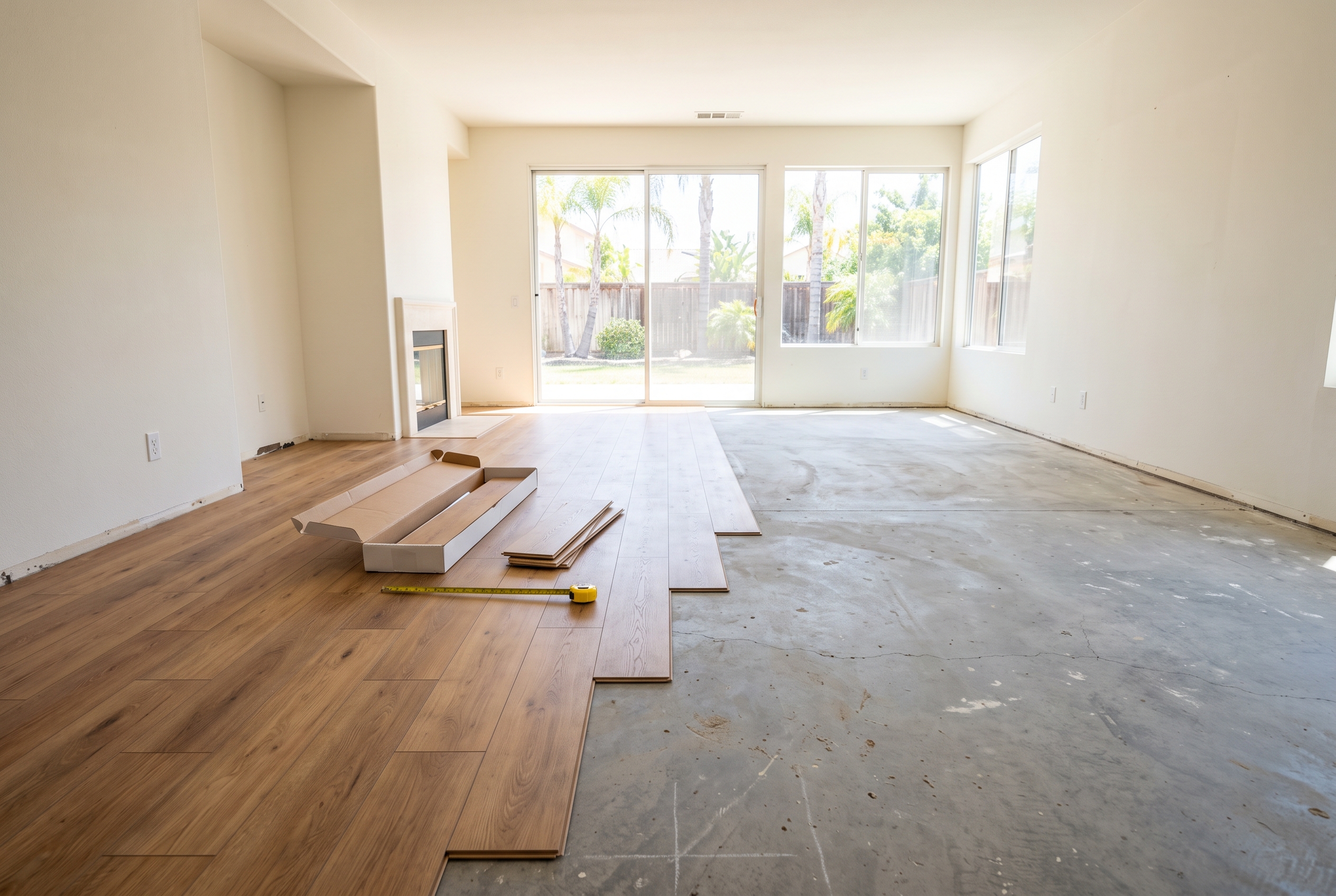
Nationally, laminate costs about $3 to $13 a square foot installed and hardwood about $6 to $25, with engineered hardwood usually $5 to $20 and solid hardwood $10 to $25. Most of the gap is the material: laminate clicks together over a pad, while wood costs more per board, takes more prep, and unfinished solid boards also need sanding and finish coats once they're down.
Those ranges come from HomeAdvisor's survey of more than 10,000 customers. They are national, and the extras around the floor, from taking up the old one to the trim and the stairs, can move a real quote as much as the floor itself.
Laminate vs Hardwood Cost per Square Foot at a Glance
Laminate is the lower-cost floor at every level, and the top of the laminate range overlaps the bottom of the hardwood range. A premium waterproof laminate can cost as much per square foot as an entry-level engineered hardwood.
| Floor | Installed per sq ft | Labor per sq ft | What moves it |
|---|---|---|---|
| Laminate | About $3 to $13 | About $2 to $8 | Thickness, texture, waterproofing |
| Engineered hardwood | About $5 to $20 | About $3 to $6 | Species, wear layer, glue or float |
| Solid hardwood | About $10 to $25 | About $3 to $6 | Species, grade, finishing on site |
The ranges are wide because the material spans so much. An 8 mm laminate and a 12 mm waterproof laminate with an embossed texture are both laminate, and red oak and walnut are both hardwood. The labor column is narrower, because a floor goes down in much the same way whatever it costs.
When you compare prices, check what each number covers. A price on a box, a sample tag or a website is usually the material alone. An installed price adds the labor to put it down. Taking up the old floor, prep, trim and stairs are usually priced on their own lines, and they are where two quotes for the same floor drift apart.
Laminate Flooring Cost Installed, From Basic to Waterproof
If you're pricing laminate, the plank itself runs from about $1 to $6 a square foot, and thickness, texture and water protection decide where a floor falls. HomeAdvisor's survey puts an 8 mm plank at about $1 to $1.80, a 10 mm plank at about $2 to $4 and a 12 mm plank at about $2.30 to $6.
A plain, smooth surface sits at the low end of those ranges, while a hand-scraped look with a deep texture can roughly double the price of the plank. A tougher, higher-rated surface adds about $1 to $3.50 a square foot, and a waterproof line with sealed joints sits at the upper end.
Labor runs about $2 to $8 a square foot, between a fifth and half of a typical laminate bill. Simple rectangular rooms are at the low end; closets, stairs, angles and many doorways push it up. Planks without an attached pad need underlayment beneath them, at roughly $30 to $60 for every 100 square feet. Over a slab, a plastic vapor barrier goes down first, even under planks with the pad attached.
The 94 laminate lines we carry run from AC3 to AC6 and from water-resistant to waterproof, so they cover most of that price span.
Engineered Hardwood Prices by Wear Layer and Install Method
Engineered hardwood runs about $5 to $20 a square foot installed, and the thickness of its top layer of real wood moves the price more than anything else. A thin veneer of oak is near the bottom of that range. A thick wear layer of a premium species in a wide, long board is near the top.
Most engineered floors are prefinished at the mill, and HomeAdvisor puts prefinished hardwood at about $5 to $15 a square foot installed, the band most engineered floors fall into. For a 300 square foot room, the full engineered range works out to about $1,500 to $6,000.
How it goes down matters too. Engineered boards can float over a pad, be glued to a slab, or be nailed or stapled to a wood subfloor, as the maker's instructions allow. Glue-down on a slab takes adhesive, a dry and flat slab and more labor, so it usually costs more than floating the same floor, though it feels more solid underfoot.
Engineered is the wood floor most homes here can use, because it goes over a concrete slab without a plywood subfloor, which is also why it often prices below solid wood on a slab. A wide-plank engineered floor with a thick wear layer can still cost more than a narrow solid oak floor, so compare specific floors rather than categories. The engineered hardwood we carry runs to 143 lines across most species, widths and wear layers.
Solid Hardwood Prices by Species and Finish
Solid hardwood runs about $10 to $25 a square foot installed, and the species moves the price most. Fixr's cost guide puts the boards alone at about $3 to $5.75 a square foot for red oak and $3.75 to $7 for white oak. Hickory runs about $4.15 to $7.15, maple about $6.25 to $10 and walnut about $8.25 to $10.50.
Prefinished boards arrive with their finish already on. Unfinished boards cost less to buy, about $2 to $6 a square foot in the same guide, but they are sanded, stained if you like, and finished in your home after they go down. Once that work is added, the two end up costing almost the same, so choose between them on looks and on the sealed seams a site finish gives, not on price.
Solid boards nail to a wood subfloor. On a concrete slab they need a plywood or sleeper subfloor built over the concrete first, which adds material, labor and height at every doorway. In a slab house, that is the line on a solid-hardwood quote that most often surprises people.
The solid hardwood we carry is mostly Bruce, in oak, hickory and maple.
The Extras That Add to Every Flooring Quote
The floor's price per square foot is only part of a quote. Taking up the old floor, preparing what's under it, trim and stairs are priced on their own, and HomeAdvisor's flooring guides price them nationally.
| Extra | How it's priced | National range |
|---|---|---|
| Removing the old floor | Per square foot | About $1 to $6 |
| Moving furniture | Per hour | About $60 to $120 |
| Leveling a slab (materials) | Per square foot | About $1 to $5 |
| Replacing subfloor | Per square foot | About $3 to $10 |
| Underlayment for laminate | Per 100 square feet | About $30 to $60 |
| Baseboard or quarter round | Per linear foot | About $5.50 to $9 |
| Stairs | Per stair | About $75 to $200 |
Moving furniture is billed by the hour, at about $60 to $120 nationally, so clearing the rooms yourself before installation day is one of the easiest savings on any quote.
Removal is the extra on almost every job. At $1 to $6 a square foot, taking up a 500 square foot floor runs about $500 to $3,000, with glued-down floors and tile at the high end and old carpet at the low end. Old hardwood comes up for about $2 to $4 a square foot.
Prep is the extra you can't see until the old floor is up. A slab with dips gets a self-leveling compound, and a soft or damaged wood subfloor gets repaired or replaced; repairs found once the old floor is up run about $900 to $3,000 in the same survey. Keeping about 15 percent of the budget aside, as HomeAdvisor suggests, covers that kind of surprise.
Trim and stairs finish the job. New quarter round or baseboard runs about $5.50 to $9 a linear foot, so a room with 60 feet of wall adds about $330 to $540. Stairs are priced per stair, and most homes have 10 to 20 of them, so a staircase of 13 stairs adds about $975 to $2,600.
Room Totals for 200, 500 and 1,000 Square Feet
For a 500 square foot living area and hall, the floor alone runs about $1,500 to $6,500 in laminate, $2,500 to $10,000 in engineered hardwood and $5,000 to $12,500 in solid hardwood. The table puts the national ranges against three common sizes.
| Floor area | Laminate | Engineered | Solid |
|---|---|---|---|
| 200 sq ft | $600 to $2,600 | $1,000 to $4,000 | $2,000 to $5,000 |
| 500 sq ft | $1,500 to $6,500 | $2,500 to $10,000 | $5,000 to $12,500 |
| 1,000 sq ft | $3,000 to $13,000 | $5,000 to $20,000 | $10,000 to $25,000 |
Add the extras to get closer to a real quote. A mid-range engineered floor in that 500 square foot area, at about $12.50 a square foot, is about $6,250. With removal of the old floor and new quarter round along 100 feet of wall, the total lands somewhere around $7,300 to $10,150 before any subfloor surprises.
A kitchen follows the same per-square-foot ranges over a smaller area, and pulling the appliances and cutting around the cabinets add to its labor.
Why Two Quotes for the Same Floor Don't Match
Two quotes for what looks like the same floor usually differ because they cover different work. One may include taking up the old floor, leveling, trim and stairs, and the other may price only the floor and its installation.
Even the floor itself can differ between quotes. The same color can come in different lines with different thicknesses, wear layers or water ratings, and the waste allowance and carton rounding change how many square feet you actually buy. Labor rates also vary from one region and one crew to the next, so national figures are a guide, and the quote for your rooms is the number that counts.
To compare two quotes, line them up item by item:
- The square footage measured, and the waste allowance added to it.
- The exact product: brand, line, color, thickness or wear layer.
- Removal and disposal of the old floor.
- Subfloor prep: leveling, repairs, a moisture test on a slab.
- Underlayment or vapor barrier.
- Trim, transitions and any stairs.
- Moving furniture and appliances.
- The labor warranty.
A quote that is lower because it leaves out prep usually becomes a change order once the old floor is up. Our own installations carry a one-year labor warranty, and that line belongs on the list beside the price.
Spending Less Without Buying a Floor You'll Replace Early
If the budget is tight, spend on the floor where the traffic and the water are and save in the quieter rooms. A mid-range floor in the bedrooms and a tougher one in the kitchen and hall stretches a budget without the house looking patched together.
Installing laminate yourself saves the labor, which is a fifth to half of the bill. Click-together laminate is the do-it-yourself floor; glue-down and nailed wood are not. If you're doing the work, our Direct Purchase program sells you the planks without installation, collected at the maker's warehouse or delivered to ours for a modest charge. Most lines can be bought that way; Proximity Mills, Doma, Newton and Paradiso are the exceptions.
The other savings are in the choices. A common species such as red or white oak costs less than walnut or maple. Standard widths and a straight layout cost less to buy and install than wide planks or herringbone. Taking up old carpet yourself and keeping sound baseboards in place trims the extras.
Hold the line on the floor's working parts. In a busy room, a thin, low-rated laminate or a wood floor with a thin wear layer saves money now and spends it again sooner, and slab prep left undone shortens any new floor's life.
Why the Cheapest Floor Isn't Always the Cheapest Over Time
Spread over its life, the floor that costs less to install can cost more per year. The home builders' study puts laminate at 15 to 25 years and engineered wood at 50 or more. A mid-range laminate in 500 square feet works out to about $200 a year, and a mid-range engineered floor to about $125, before upkeep.
Wood does need upkeep: a fresh coat every few years in busy rooms, and a refinish when the finish wears through. Laminate needs none until it is replaced.
So the answer turns on how long you'll stay. If you'll move within five or ten years, laminate is the cheaper floor by a wide margin, and a buyer sees a fresh floor. If you'll stay for decades, a well-kept wood floor catches up and keeps going after a laminate floor would have been replaced.
Laminate and Hardwood From Perry Floors
At Perry Floors, the price that matters is the one for your rooms, and we work it out in your home at no charge. One of our project specialists measures your rooms and prices the floor you chose, with your subfloor and layout in the figure rather than a national range.
Before that visit, narrow the choice to two or three floors. Order samples of the species and laminate lines you like, or compare them side by side at either of our Upland showrooms. If you need laminate soon, our Quick Ship laminates are generally available the next business day.
Every floor we install goes down with licensed installers, and financing lets you spread the cost over months.
Questions About Laminate and Hardwood Costs
What Does It Cost to Floor a 12-by-12 Room?
A 12-by-12 room is 144 square feet, so at national installed prices it runs about $430 to $1,870 in laminate, $720 to $2,880 in engineered hardwood and $1,440 to $3,600 in solid hardwood.
Taking up the old floor adds about $145 to $865 at $1 to $6 a square foot, and new quarter round around the room adds a few hundred more. Small rooms can also carry a minimum labor charge, so a single room often costs more per square foot than a whole floor.
Can Laminate Go Over My Old Floor?
Yes, laminate can often go over the old floor, which saves the cost of removal. NALFA's guide to subfloors allows it over flat, sound ceramic or porcelain tile, level sheet vinyl or linoleum with a pad, flat vinyl plank, and stable hardwood, but never over carpet, old laminate or bamboo.
The new floor sits higher, so check doors, the dishwasher and transitions before you skip removal, and the old floor has to be flat and firmly attached.
Is It Cheaper to Refinish Hardwood Than Replace It?
Yes, refinishing a sound hardwood floor is cheaper, costing two to three times less than replacing it with new hardwood, at about $3 to $8 a square foot nationally. A screen and recoat, for a finish that is dull but not worn through, costs less again.
Replacing makes sense when water has damaged the boards or past sandings have used up the wood above the tongues.
How Much Extra Flooring Should I Order?
Order about 5 percent extra as a waste allowance for a straight layout, 10 percent for diagonal and 15 percent for herringbone, then round up to whole cartons. For a 500 square foot room laid straight, that means about 525 square feet before the carton round-up.
The waste allowance depends on the layout, and the leftover planks are worth keeping for repairs.
Does Hardwood Pay for Itself When You Sell?
Not dollar for dollar as a rule, but real wood helps a house sell. A floor of engineered or solid wood can be listed as hardwood, and hardwood is one of the features buyers pay more for.
If you'll sell within a year or two and want new floors for the listing, a good laminate gives the house a fresh floor for less.
Let's Measure Your Rooms
National ranges tell you what to expect, and your own rooms set the real number. Once you've picked a floor or two to compare, we measure your rooms and price the floor you chose.


