

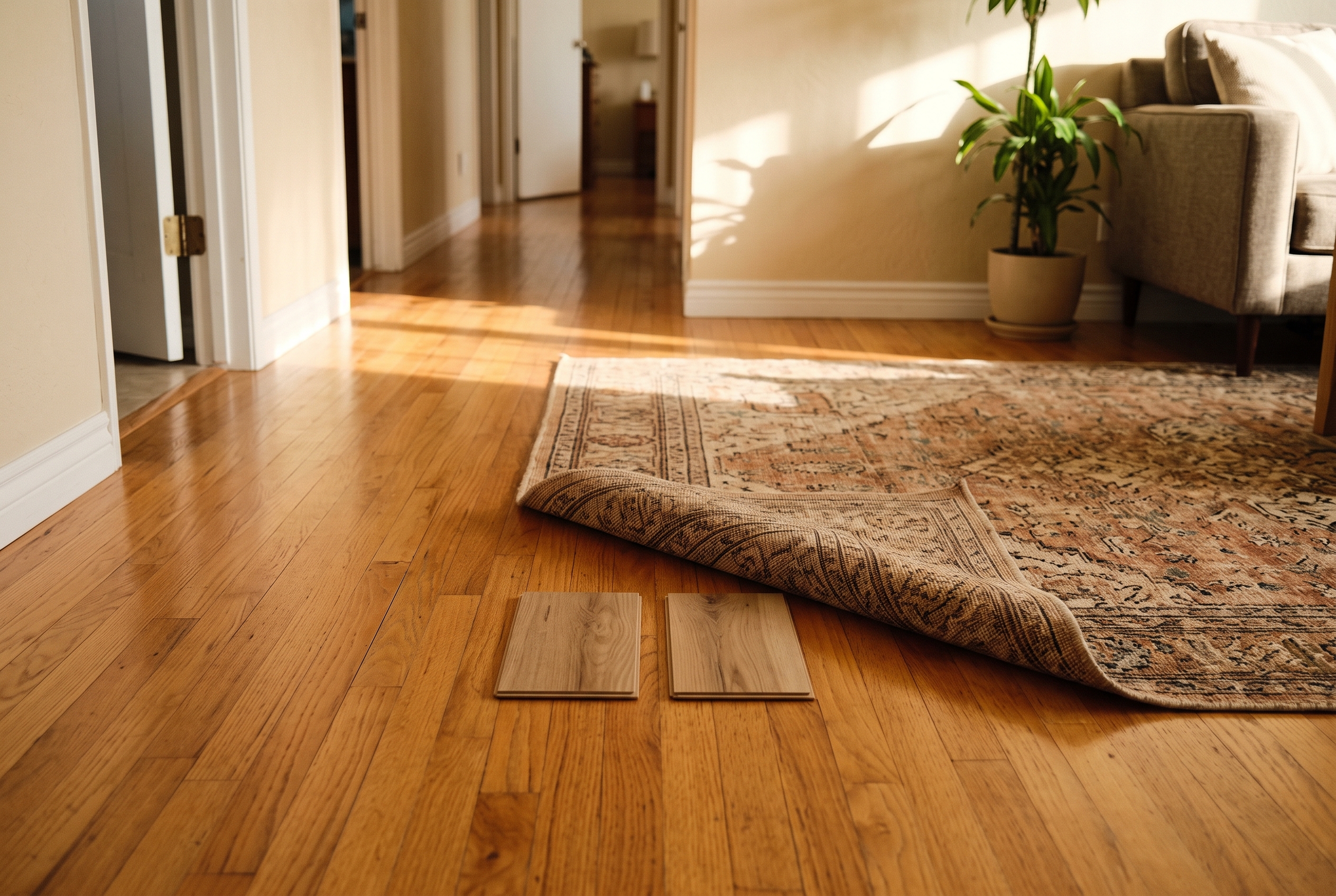
A laminate floor usually gives 15 to 25 years before its printed surface wears through in the traffic paths or its seams give out. A dry AC4 floor in a quiet house can go past that. Hardwood lasts longer because it can be sanded back to fresh wood: engineered hardwood gives 50 years or more when its top layer is thick enough to sand, and solid hardwood can outlast the house.
On a wood floor, the finish wears out long before the wood does, usually within a decade in the busiest rooms. Renewing that finish on time is what turns the long numbers into your floor's real life.
Years of Service for Laminate, Engineered and Solid Hardwood
In the National Association of Home Builders' study of how long home components last, laminate floors run 15 to 25 years, engineered wood 50 years or more, and natural wood floors 100 years or more. Wood floors as a group are rated for a lifetime, the same rating the study gives a house's framing and foundation.
The study is also plain that a floor's life depends on how well it was installed, how it is kept, the climate and how hard it is used. Those four are where the years in the table are won or lost.
| Floor | Typical years | What ends it | Can it be renewed? |
|---|---|---|---|
| Laminate | 15 to 25 | Worn pattern, swollen seams | No; planks are replaced |
| Engineered hardwood | 50 or more | Wear layer sanded away | Yes, if the wear layer allows |
| Solid hardwood | 100 or more | Too many sandings, water | Yes, six to eight times |
You'll find laminate quoted anywhere from 10 to 30 years and hardwood from 30 to over 100. The spread comes from quality, traffic and water more than from the material. A thin plank in a busy hall and a premium plank in a guest room are both laminate, and they won't last the same number of years.
How Many Years Laminate Flooring Gives
Laminate flooring gives 15 to 25 years in most homes. Where a floor lands in that range comes down to its surface rating against the traffic, water at its seams, the flatness of the floor beneath it and the grit walked across it.
The surface rating matters most in busy rooms. Laminate's top layer is graded by its AC rating, and a plank rated for more traffic than it gets looks new longer. Most of the rated laminate we carry is AC4, the class built for a whole busy house, so a family kitchen and hall sit well inside its range. Thickness doesn't change how long the surface lasts, though a thicker plank holds its joints and resists dents better.
Water ends more laminate floors early than anything else. Laminate's core is wood fiber pressed under heat, and water that gets into a seam swells it for good. Waterproof laminate, with sealed joints, takes everyday spills off the list, and that alone moves a floor toward the top of the range. It won't stop a slow leak spreading under the floor, and it won't stop grit.
A good installation protects the rest of those years. A floating floor laid over dips in the subfloor flexes at its joints every day until they loosen, and a floor laid without its expansion gap at the walls can buckle in a humid week. Neither shows up for a year or two, and both shorten a floor's life more than its thickness does.
Sun is the one thing laminate shrugs off, since its printed pattern keeps its color in a bright room where wood slowly changes shade. What laminate can't do is start over: when the pattern wears through in the traffic path, those planks are replaced.
Why Solid Hardwood Can Outlast the House
Solid hardwood can outlast the house because every time its surface wears out, a sander can take it back to fresh wood. A 3/4-inch board has a good layer of wood above its tongue for those sandings. The National Wood Flooring Association's technical director puts most solid floors at six to eight sandings over a floor's service life.
Each full sanding takes off a thin layer, so the count depends on the sander's skill and on how flat the floor is as well as on the board. In busy rooms, a floor whose finish is allowed to wear through needs a full refinish every seven to 10 years. At that pace, six to eight sandings carry a floor for well over half a century, and a floor recoated before the finish wears through needs far fewer of them.
What ends a solid floor is rarely wear. Water that rots or blackens the boards, a subfloor that moves, or so many sandings that the tongues or nail heads show are what finish it. Solid boards nail to a wood subfloor, so they belong on a raised foundation; on a slab they need a plywood subfloor first. The solid hardwood we carry is mostly Bruce, with Indusparquet's Solido line.
Engineered Hardwood Lifespan Depends on the Wear Layer
An engineered hardwood floor lasts as long as its top layer of real wood allows, so the wear layer printed on its spec sheet tells you more than the brand does. Under that wear layer is a stable, plywood-style core that holds up for decades. The real wood on top is the part that can only be sanded so far.
The National Wood Flooring Association says engineered wear layers run from about 1/16 to 1/4 inch, and that sanding isn't recommended once a wear layer is thinner than 3/32 inch, about 2.4 millimeters. In practice, a 2 mm wear layer sits under that line and is renewed by recoating, while a 4 mm layer can take a full sanding or more. HomeAdvisor's cost guide puts the practical limit for engineered planks at one or two refinishings, which fits floors with mid-range wear layers.
Most engineered floors never reach that limit, because most wear on an engineered floor is in the finish rather than the wood. A screen and recoat renews the finish without cutting into the wood, so a floor recoated before its finish wears through may never need a full sanding, and its wear layer stays in reserve.
To find your wear layer, read the spec sheet for the line, or look at a board's edge where it shows at a floor vent or a stair. That edge also tells you which floor you have: engineered shows a thin top layer over a layered core, while solid is one piece of wood all the way through. The engineered hardwood we carry runs to 143 lines, and each line's spec lists its wear layer.
The Finish Wears Out Long Before a Wood Floor Does
A wood floor has three lives: the finish on top, the wear layer of real wood under it, and the boards themselves. The finish runs out first, often within a decade in a busy kitchen or hall, while the wood under it is fine. Renewing the finish on time is the cheapest way to keep a wood floor for decades.
A screen and recoat is the light job. The old finish is lightly abraded so a new coat will bond, and a fresh coat goes on with no sanding into the wood. It works while the finish is dull or scratched but not worn through to bare wood. A full refinish sands to bare wood and starts over, for scratches that reach the wood, grey worn paths or a color change.
| Job | When | What it does | National cost |
|---|---|---|---|
| Screen and recoat | Every 3 to 5 years in busy rooms | Renews the finish; no sanding | About $1 to $2.50 a sq ft |
| Full refinish | Every 7 to 10 years if needed | Sands to bare wood; new finish | About $3 to $8 a sq ft |
| Replace the floor | Wood used up or water-damaged | New boards | Two to three times a refinish |
Those costs come from HomeAdvisor's survey of more than 10,000 customers, which puts a full refinish at about $3 to $8 a square foot and the screening step at about $1 to $2.50. The average refinishing project in that survey comes to about $1,900, with most between about $1,100 and $2,700, and refinishing runs two to three times cheaper than replacing the floor. A fresh coat every three to five years in the busiest rooms keeps most floors away from the full refinish.
Why a Warranty's Years Aren't the Floor's Lifespan
A warranty tells you what the maker will fix if something goes wrong, not how long the floor will look good in your house. Our warranty page lists laminate coverage from up to 10 years to lifetime and structural warranties on hardwood and engineered wood from up to 15 years to lifetime, depending on the maker.
A structural warranty on engineered wood is about the layers staying bonded together. A wear warranty on laminate covers the pattern wearing through under normal household use. Neither covers a dull finish, everyday scratches, a leaking pipe or a floor you simply outgrow, and both assume the floor went in and was kept the way the maker asks.
So a lifetime warranty doesn't promise a lifetime floor, and a floor with a 25-year warranty can last far longer. The paperwork with your floor is what counts, and our installations carry a one-year labor warranty on top of whatever the maker covers.
What Shortens a Floor's Life in an Inland Empire Home
Water, grit and sun shorten a floor's life more than anything else here, with dry air close behind for wood. Each has a simple fix that gives the years back.
Water does the most lasting harm, because its damage is permanent on laminate and costly on wood. Slow leaks under sinks and dishwashers, pet accidents left overnight and wet mopping are the usual sources. Fix a drip the week you notice it, wipe spills when they happen, and mop with a well-wrung mop or whatever your floor's maker allows.
Grit works like sandpaper on the soles of shoes. On windy days fine sand blows in through every open door, and it grinds the finish on wood and the pattern on laminate along the same paths. A doormat outside and another just inside each entry, plus a quick sweep before the sand gets ground in, take care of most of it.
Strong sun slowly ambers or lightens wood, and you see it when you lift a rug that sat in one spot for a year, while laminate keeps its color. Shift your rugs every few months on a wood floor, and draw the shades on west windows during the hottest part of the day.
Dry air is wood's other enemy. Dry air pulls moisture out of wood and opens gaps between the boards, and our long dry stretches make that a real concern here. The National Wood Flooring Association suggests 30 to 50 percent humidity indoors, while Provenza asks for 35 to 55 percent for its floors. Follow the maker of yours, and run a humidifier in the driest months.
Claws and furniture scratch both floors. On wood, the boards outlast any dog, and it is the finish that takes the scratches, so a dog household recoats sooner. Protecting each chair and table leg with a felt pad, keeping nails short and swapping hard plastic casters for rubber ones stop most of the damage. A floor laid over a damp slab or an uneven subfloor will have a shorter life however carefully it is kept, so testing the slab and flattening the subfloor before installation protects those years.
Signs a Laminate Floor Is Near the End
A laminate floor is near the end when its pattern has worn through in the traffic paths, its seams have swollen, or its joints no longer hold. Some of those can be fixed plank by plank; others mean the floor is done.
A worn pattern shows as a grey or blank patch at the sink, the door or down the hall. It can't be refinished, so the worn planks are replaced, and when the wear runs through every room, the floor is finished. Swollen or peaked seams mean water reached the core, and those planks are replaced once the source is fixed and the area is dry.
Chips along the plank edges come from hard hits. A color-matched putty such as Pergo's Finishing Putty fills small dings on its planks, and larger damage means a new plank. Since laminate isn't fastened to the subfloor, a single damaged plank can be swapped without redoing the room: the rows between it and the nearest wall unclick and go back in. A box of spare planks from the installation makes that repair match, and Mohawk recommends keeping extra planks for repairs.
Joints that click, gap or feel soft underfoot mean the floor is flexing over a low spot or the locking edges are worn. A low spot can be lifted and leveled. When the joints are loose across the whole room, the floor has reached its end.
Signs a Hardwood Floor Needs Refinishing, Not Replacing
Most worn hardwood needs refinishing, not replacing. If the boards are sound and there is wood left to sand, a dull, grey or scratched floor comes back with a new finish.
To check the finish, drip a few drops of water on the busiest path. If they bead, the finish is still protecting the wood. If they soak in and darken the board, the finish is worn through there and a full refinish is due. Grey paths at doorways, scratches your fingernail catches in, and boards that look bare in the light all say the same.
Replacing is for the boards themselves. Black stains that go through the wood, cupping that stays after the floor has dried out, boards that move or feel spongy, and tongues or nail heads showing after past sandings all mean new boards. To see how much wood is left, look at a board's edge where it shows at a floor vent or a threshold.
Water damage, a moving subfloor and boards sanded too thin are the cases where replacing beats refinishing. Nearly everything else is a refinish.
How to Make a New Floor Last Longer
A new floor lasts longer when the right one goes in correctly and its first few years are kept free of grit and standing water. These steps add the most years.
- Buy for the busiest room. Choose the laminate class, or the wood species and wear layer, for the traffic in the kitchen and hall rather than the guest room.
- Match the floor to the subfloor: engineered or laminate on a slab, solid on a wood subfloor.
- Start dry and flat. Test the slab for moisture and flatten the subfloor to the maker's limit before anything goes down.
- Let the floor adjust if the maker asks. Some need a day or two in the room before installation; the instructions in the carton say.
- Stop grit at the door, and sweep often.
- Pad every chair and table leg, and put rubber casters on rolling chairs.
- Keep water off: wipe spills, damp-mop only, and look under the sinks each season.
- Hold the humidity in the range your maker gives, and shade strong sun.
- Recoat wood before the finish wears through, every few years in busy rooms, and keep the cleaning routine your floor's warranty expects.
What Each Floor Costs per Year of Service
Spread over its life, a wood floor often costs less per year than laminate, even though it costs more to install. The table uses mid-range national prices from HomeAdvisor's survey for a 500 square foot area and the typical years from the home builders' study.
| Floor | Installed, 500 sq ft | Typical years | Floor cost per year |
|---|---|---|---|
| Laminate | About $4,000 | About 20 | About $200 |
| Engineered hardwood | About $6,250 | About 50 | About $125 |
| Solid hardwood | About $8,750 | About 100 | About $90 |
Those per-year figures leave out upkeep, and wood needs some. For 500 square feet, a screen and recoat runs about $500 to $1,250 every few years in busy rooms, and a full refinish about $1,500 to $4,000 when it's needed. Laminate has no upkeep bill, but its whole cost comes due again when it is replaced.
Look at the same three floors 20 years in. The laminate floor has cost about $4,000 and is near the end of its life. The engineered floor, with two recoats along the way, has cost about $8,000 and has decades left. The solid floor has cost about $10,500 with the same two recoats and is barely a fifth of the way through its life.
All of that assumes you stay. Over five or ten years, laminate is the cheaper floor by a wide margin, and a lot of floors are replaced for taste or a remodel long before they wear out.
Which Floor Fits How Long You'll Stay
How long you'll stay in the house is the best guide to which floor pays off. Under about five years, laminate gives you the best floor for the money, and buyers see a clean, new floor. If you already have hardwood, refinishing it is usually the better spend than replacing it.
Between five and fifteen years, either floor makes sense. Laminate wins on price and through the years of dogs and small children; engineered hardwood wins on feel and on how the house lists when you sell.
Past fifteen years, wood is the floor that can go the whole way. Engineered with a thick wear layer suits a slab, and solid suits a raised foundation. With a toddler and a puppy in the house now, laminate for those years and wood later is a reasonable plan that spends on each floor where it does the most good.
A rental is its own case. A waterproof AC4 laminate survives turnover, and a damaged plank is a small repair between tenants.
Long-Lasting Laminate and Hardwood at Perry Floors
At Perry Floors, we carry laminate and hardwood built for the long numbers: AC4 laminate across 35 lines, waterproof laminate in Mannington's Restoration Collection and Mohawk's RevWood, and hardwood in 143 engineered and 27 solid lines. To compare species and constructions, filter our hardwood by construction and species, then take samples home to see in your own light.
A floor's life is set on installation day as much as on the day you choose it, so we install the floors we sell with licensed installers. See the long-lasting lines in person at either of our Upland showrooms, and we price your rooms in your home at no charge, with your subfloor counted in.
Questions About How Long Floors Last
Does Laminate Fade in the Sun?
No, laminate holds its color in the sun far better than wood, because its pattern is printed and sealed under a hard top layer. Mohawk backs its RevWood laminate with a fade warranty.
Wood is the floor that changes in sunlight, ambering or lightening over the years. That is normal for wood and not a defect, and moving rugs every few months keeps the color even across the room.
Is an Old Hardwood Floor Worth Saving?
Yes, an old hardwood floor is usually worth saving when its boards are sound and there is still wood above the tongues. Refinishing costs two to three times less than replacing, and older solid oak often has years of sanding left.
The first thing to check is how much wood is left above the tongues, since a floor sanded several times before may be near its limit. A floor with black stains or loose boards may need some boards replaced first, and the rest can still be refinished.
How Long Does Hardwood Last With Dogs?
Hardwood still lasts decades with dogs, because the boards outlast the claws; it is the finish that wears faster and needs renewing sooner. Recoating more often keeps the scratches in the finish and out of the wood.
Harder species and a matte, textured finish hold up best to a big dog, and trimmed nails help any floor.
Can Laminate Be Refinished?
No, laminate can't be sanded or refinished, because its pattern is a printed layer only a fraction of a millimeter thick. When it wears through, the worn planks are swapped for new ones.
Spare planks kept from the installation are what make that swap blend in, since a plank from the same batch matches when a new one might not.
Pick the Floor for the Years You Plan to Stay
The right floor is the one that lasts as long as you'll be there, at a cost per year you're comfortable with. When you've settled on the years you have in mind, we measure your rooms and price both floors for that stretch of time.


