

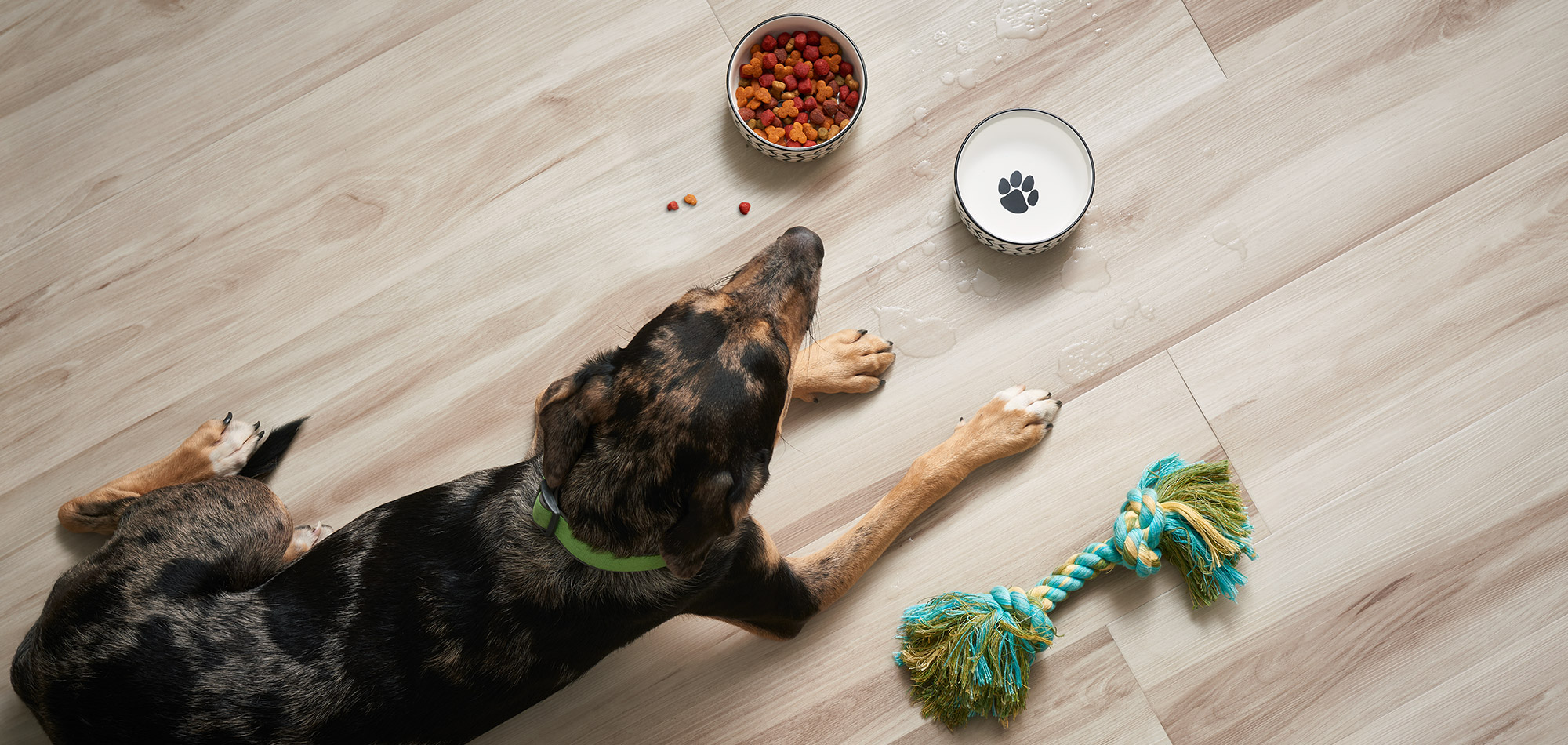
Real hardwood can live with a big dog, but only if you choose it for the job. Three things decide whether a wood floor shrugs off a Labrador or shows every nail: how hard the wood species is, what finish sits on top, and whether the board is solid or engineered. Get those right and a wood floor takes years of paws and zoomies in stride. Get them wrong and it looks tired in a season. Here's how to pick a floor that stays handsome with a dog in the house.
Can Hardwood Really Handle a Big Dog?
Hardwood can handle a big dog, as long as you go in knowing no wood floor is scratch-proof. A dog's nails are hard, and enough grit under enough traffic will eventually mark any wood surface. No floor is bulletproof. What changes the outcome is the combination you choose: a harder species, a finish that hides wear, and a construction that stays flat in our dry Southern California air. Done well, a wood floor lives with a large dog for years and refinishes back to new later. If you want the wider view across every material, our deep dive on the best flooring for scratches from large dogs ranks wood against tile and vinyl, and this piece is the wood-specific version of that answer.
Which Wood Species Stand Up to Dog Claws?
The harder the species, the better it resists a dog's nails, and hardness is measured on a scale called the Janka test. The test presses an 11.28 mm steel ball, about 7/16 inch, halfway into a board and records the force in pounds it takes, so a higher Janka number means a harder, more dent-resistant wood. It's the standard way the industry compares species, and for a dog household it's the first number to check. Red oak, the baseline for American flooring, comes in around 1,290 and white oak sits a little above at 1,360 lbf. Go harder and you get hickory at about 1,820, the toughest common domestic wood, and imported Brazilian cherry at roughly 2,350, nearly double red oak.
Species | Janka hardness (lbf) | With a big dog |
|---|---|---|
Brazilian cherry (jatoba) | 2,350 | Hardest common option; shrugs off claws |
Hickory | 1,820 | Toughest domestic wood; excellent |
Hard maple | 1,450 | Solid choice; a touch softer than oak look |
White oak | 1,360 | Great all-rounder; hides grain wear |
Red oak | 1,290 | Baseline; workable with the right finish |
Black walnut | 1,010 | Beautiful but dents; think twice |
American cherry | 950 | Softest here; not for heavy paws |
For a big, active dog, oak is the sensible floor and hickory is the tough one. Red and white oak, in the 1,290 to 1,360 range, give you a hard surface, an open grain that helps disguise fine scratches, and the widest selection of colors. Hickory steps up the hardness for a home with a very large dog or several of them. Save walnut at about 1,010 and cherry at about 950 for a bedroom the dog doesn't rule; their beauty comes with a softer surface that dents.
Why the Finish Matters as Much as the Wood
The finish decides whether the scratches that do happen actually show, and it is the single most overlooked choice in a dog household. A high-gloss floor acts like a mirror and reveals every hairline mark, while a matte or low-gloss finish scatters light and hides them. Skip the gloss. A wire-brushed texture, where the surface is lightly raked to bring out the grain, hides fine scratches and dents best of all, because the floor already has texture for a claw mark to disappear into. Many factory finishes are also fortified with aluminum oxide, a hard ceramic added to the topcoat that raises surface hardness well above bare wood. For a dog, the winning combination is a hard species in a matte or wire-brushed, factory-applied finish.
Solid or Engineered Hardwood for a Dog Household?
For most Inland Empire homes with dogs, engineered hardwood is the smarter build, because it stays flat over a concrete slab and through our dry summers while giving you the same real-wood surface a dog meets. Engineered hardwood is a layer of real wood bonded over a cross-layered plywood or fiberboard core, so the top you walk on is the same species, at the same Janka hardness, as a solid board, while the core underneath resists the cupping and gapping that dry indoor air causes. Wood floors hold up best when the house stays between 60 and 80 degrees and 30 to 50 percent relative humidity, the window the National Wood Flooring Association (NWFA), the trade group that writes the installation standards for wood floors, publishes, and a slab-on-grade Upland home in July can drift outside it. Engineered construction is more forgiving of that drift.
Solid hardwood still has one edge that matters to dog owners: it can be sanded and refinished more times over its life. Engineered floors can be refinished too, and how often comes down to the thickness of that real-wood top layer. A 3 mm wear layer takes two to three full sandings, a 2 mm layer is good for one light refinish, and a thick 4 mm layer handles three to five, because each sanding pass removes only about half a millimeter to a millimeter of wood. For a dog household, a hard-species engineered floor with a 3 mm or thicker wear layer is the sweet spot: it survives the slab and the dry air, and it still lets you sand out years of wear down the road. You can see the range of species and constructions on our hardwood page, and our hardwood buyer's guide covers the wider selection.
Keeping a Wood Floor Looking Good With Dogs
Day-to-day care with a dog is mostly about grit and nails, and a short routine keeps a wood floor sharp. Keep the dog's nails trimmed, since long nails do most of the damage. Put washable mats at the doors the dog uses and under the food and water bowls, sweep or dust-mop the grit that acts like sandpaper underfoot, and wipe up water bowl splashes so they do not sit. Hold indoor humidity in that 30 to 50 percent range with the HVAC, especially during a dry stretch. When the finish finally looks dull, a screen-and-recoat, which scuffs the old topcoat and lays a fresh one without sanding to bare wood, brings back the shine for a fraction of a full refinish.
When Wood Is Not the Right Call
If you have a very large, very active dog and no patience for a single mark, a wood floor will probably frustrate you, and a harder surface is the honest recommendation. Porcelain tile is nearly impossible to scratch, and a good waterproof vinyl plank resists claws and accidents while looking like wood. Those alternatives come down to the same trade-off between looks and toughness, and you can browse the wood-look options on our luxury vinyl page. The scratch resistance of those hard-surface floors is graded by an abrasion scale called the AC rating, set by the European standard EN 13329, and the top residential grades handle claws that would mark softer wood. Choosing wood is a decision to accept a little character in exchange for real timber underfoot, and plenty of dog owners happily make that trade.
Questions Dog Owners Ask About Hardwood
What is the best hardwood floor for a big dog?
A hard species in a matte or wire-brushed finish is the best hardwood floor for a big dog. Oak, at a Janka hardness of about 1,290 to 1,360 on the scale, is the practical choice, and hickory, near 1,820, is the toughest common domestic wood for a home with a very large or very active dog. Pair that species with a low-gloss, factory-applied finish and the floor hides the marks a dog leaves.
Do dogs scratch engineered hardwood less than solid?
No, they scratch the same, because the surface is identical. Engineered and solid boards of the same species and finish have the same Janka hardness on top, so a claw treats them alike. Engineered wins for a different reason: its stable core holds flat over a slab and in dry air, which is why it's the better build for most Inland Empire homes, dog or no dog.
Does a matte finish really hide dog scratches?
Yes, and it makes a bigger difference than most people expect. A matte or low-gloss finish scatters light instead of reflecting it, so fine scratches and dents fade into the surface rather than catching the eye. A wire-brushed texture hides them better still. High-gloss floors do the opposite and show every mark, which is why they are the wrong pick for a dog household.
Is hickory or oak better for a dog?
Both are good, and the choice is hardness against selection. Hickory is harder, around 1,820 on the Janka scale versus roughly 1,290 to 1,360 for oak, so it resists denting from a big dog a little better. Oak comes in more colors and styles and its open grain hides wear well, so it's the more popular dog-household floor. Either one, in a matte finish, holds up.
Can scratched hardwood be fixed?
Yes, and that is one of real wood's advantages over a printed floor. Light surface scratches often buff out or hide under a screen-and-recoat, which refreshes the finish without sanding. Deeper gouges come out in a full sand-and-refinish, which a solid floor or a thick-veneer engineered floor can take several times over its life. A printed laminate or vinyl, by contrast, has to be replaced when it wears through.
See Dog-Friendly Wood Floors in Upland
The easiest way to choose is to stand on a few samples and see how the finishes hide wear. We're a family-owned shop with two showrooms in Upland, we install hardwood across the Inland Empire, and we'll steer you toward the species, finish, and construction that fit your dog and your rooms rather than the priciest board on the rack. When you're ready, request a free in-home estimate and we'll measure the space and help you pick a wood floor built to live with your dog.


