

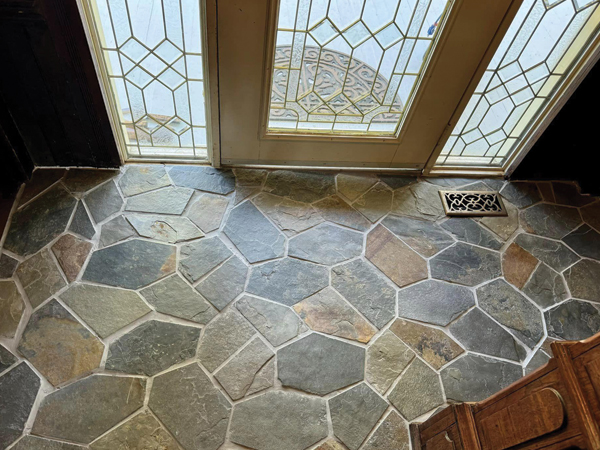
Natural stone is the one flooring material that was never manufactured to look like anything else. Every marble, travertine, slate, limestone and granite floor is a slice of geology — formed over millions of years, quarried, cut and finished — and no two tiles are ever identical. That authenticity is why stone keeps showing up in Inland Empire remodels, from mid-century ranch homes in Upland and Ontario to newer two-story builds in Rancho Cucamonga and Eastvale. Perry Floors stocks 155 options in the natural stone catalog, spanning all five of the classic flooring stones, so this guide is built around a practical question: which stone belongs in which room of your home?
The five stones behave very differently. Some shrug off dogs and cleats; some etch if a lemon wedge sits on them overnight. Some need sealing twice a year; some barely absorb water at all. Below you’ll find the character, hardness, porosity, finish options and care rules for each — plus interactive tools to compare them side by side. If you want visual ideas first, the inspiration galleries are a good place to see how these materials photograph in real spaces.
Cool Underfoot: Why Stone Suits Hot, Dry Summers from Upland to Redlands
Start with the local argument, because it’s a strong one. Inland Empire summers routinely run 95-105°F for days at a stretch, the sun is intense, and the air is dry. Stone flooring has high thermal mass — it absorbs heat slowly and releases it slowly. Inside a home in Upland, Claremont or Redlands with the air conditioning cycling, a stone floor settles at the cool end of the room’s temperature range and stays there. Walk barefoot across a travertine hallway on a 102°F afternoon in Rancho Cucamonga and the floor feels several degrees cooler than the air, because dense stone pulls heat out of your skin faster than carpet or wood can. That same mass smooths out the big day-night temperature swings this region is known for.
Dry heat also removes one of stone’s few climate worries. In humid regions, moisture drives mold into grout and feeds efflorescence; here, low humidity keeps stone installations remarkably stable. And because most homes from Ontario to Fontana sit on concrete slabs, stone tile has an ideal base — a properly prepared slab is flat, rigid and made of similar mineral material, which is exactly what a stone installation wants. Perry Floors’ licensed installers handle that slab prep, membrane and layout work as part of their residential and commercial flooring services.
One honest caveat: thermal mass works both ways. A stone floor in front of a big west-facing slider can soak up direct sun all afternoon and radiate that heat into the evening. Deep overhangs, patio covers or good window film keep the effect on your side. In winter, the same floor feels cool — which is why many stone fans add area rugs seasonally, or pair stone with radiant heat in bathrooms.
The Five Flooring Stones at a Glance
Here is the short version of the whole guide in one table, followed by a closer look at each stone. Hardness is given on the Mohs scale, the standard 1-10 mineral hardness scale where talc is 1 and diamond is 10 — more on what those numbers mean for a real floor in a moment.
| Stone | Mohs hardness | Porosity | Typical finishes | Best rooms |
|---|---|---|---|---|
| Marble | ~3 | Moderate | Honed, polished | Formal living, baths, low-traffic elegance |
| Travertine | ~3-4 | High (filled or unfilled) | Honed, tumbled | Entries, halls, indoor-outdoor transitions |
| Slate | ~4-5.5 | Low to moderate | Natural cleft, honed | Entries, mudrooms, kitchens |
| Limestone | ~3-4 | High | Honed, tumbled | Baths, bedrooms, quiet living areas |
| Granite | ~6-7 | Low | Polished, honed, flamed | Kitchens, high-traffic areas, busy families |
Tap each stone for its profile, Mohs hardness gauge and quick facts.
Marble is metamorphosed limestone — heat and pressure recrystallize it into the veined, luminous stone of classical architecture. It reads as light, formal and elegant, and it takes a glass-like polish no other flooring stone matches. The trade-off: it is soft (Mohs ~3), and its calcite chemistry etches on contact with acids.
Travertine forms around mineral hot springs, which leaves it riddled with natural voids. Those pits are usually factory-filled, giving the stone its warm, banded, earthy character in cream, walnut and gold tones. At Mohs ~3-4 it wears a little better than marble, and its variegated pattern hides everyday scuffs well.
Slate is a fine-grained metamorphic rock that splits naturally into layered sheets, which is why its classic look is the textured “natural cleft” surface. Colors run from charcoal and rust to green and multicolor blends. At Mohs ~4-5.5 it is the middleweight of the group, dense enough to shed water and grippy enough for entries.
Limestone is the sedimentary parent of marble — soft, sandy, even-toned, often carrying tiny fossil traces. It delivers that sun-washed, European-farmhouse look that suits both foothill homes in Claremont and ranch layouts in Ontario. Like marble it is calcite-based (Mohs ~3-4), so it shares marble’s sensitivity to acids and its need for sealing.
Granite is igneous rock — cooled magma, crystallized into a dense interlocking matrix of quartz and feldspar. At Mohs ~6-7 it is by far the hardest and least porous of the five, which is why it moved from countertops to floors in busy households. Its look is speckled and mineral-rich rather than veined, in colors from salt-and-pepper gray to deep black and warm gold.
A note on family resemblance: marble, travertine and limestone are all calcium carbonate stones — geologically, travertine and limestone are the younger relatives and marble is what they become under heat and pressure. That shared chemistry is why all three follow the same care rules. Slate and granite are the outsiders: different minerals, different behavior, far more forgiving. If you also love these materials on counters, the same families appear in Perry Floors’ quartz, granite and marble surfaces — the about countertops page covers how they perform there.
How Hard Is Hard? What Mohs Numbers Mean on a Real Floor
The Mohs scale measures scratch resistance: a mineral can scratch anything rated below it and is scratched by anything above it. The everyday reference points make the flooring implications obvious. A steel knife blade sits around 5.5. Ordinary quartz sand — the grit that blows in on every Santa Ana wind event and rides in on sneakers — is a 7.
Run the numbers against the five stones. Marble at ~3 and travertine and limestone at ~3-4 are all softer than the sand on your doormat, which means grit ground underfoot will slowly abrade a polished surface into dullness along traffic lanes. Slate at ~4-5.5 resists casual scratching much better, and its cleft texture disguises what does happen. Granite at ~6-7 essentially ties with the sand itself — it is the only flooring stone that quartz grit struggles to scratch, which is why a granite floor in a busy Fontana household can look nearly new a decade in.
Two practical conclusions follow. First, hardness should scale with traffic: soft stones belong in calmer rooms or in honed finishes that do not show wear, while entries and family hubs favor slate and granite. Second, walk-off mats at every exterior door are the cheapest floor protection ever invented, because they capture the quartz grit before it becomes sandpaper. Want to see how a specific stone look reads in your own space before committing? Upload a photo to the flooring visualizer and preview products in your room.
Porosity and Sealing: The Rule Most Stone Owners Learn Too Late
Every natural stone is at least slightly porous — a network of microscopic capillaries that can wick in water, wine, pet accidents and cooking oil. A penetrating sealer soaks into those capillaries and buys you reaction time: spills bead up on the surface for minutes instead of soaking in within seconds. Sealing is not optional maintenance on most stone floors; it is the difference between a five-minute wipe-up and a permanent stain.
How often you reseal depends on the stone and the finish. Travertine and limestone are the sponges of the group — open-structured, thirsty, needing sealer roughly every six to twelve months in kitchens and baths. Marble is somewhat tighter, and a polished surface slows absorption further. Slate is denser still, and many granites are so tight that a few go years between applications — the classic test is to leave a few drops of water on the stone: if the spot darkens within ten minutes, it is time to reseal. Use the meter below to see where each common combination lands.
Tap a stone-and-finish combination to see how much sealing attention it needs.
Sealer choice matters as much as schedule. Penetrating (impregnating) sealers soak in and are invisible; topical sealers sit on the surface and can add sheen but show wear. And one crucial clarification for the calcite stones: sealer resists staining, not etching. Acid etching is a chemical burn of the stone itself — no sealer prevents it. That distinction drives the cleaner rules later in this guide.
Honed, Polished or Tumbled: Choosing the Right Finish
The same block of stone becomes three very different floors depending on how the surface is finished, and finish choice affects slip resistance, glare, maintenance and style as much as the stone species does.
Honed means ground smooth but stopped short of gloss: a matte to satin surface with soft, even light. Honed is the workhorse finish for floors — it hides fine scratches and etch marks far better than polish, offers better traction when damp, and reads relaxed and modern. Its trade-offs: colors look slightly muted, and the more open surface absorbs a bit faster, so sealing matters more. Honed suits nearly every room, and it is the safest call for marble, travertine and limestone floors.
Polished is buffed to a reflective shine that saturates the color and makes veining glow — the formal, luxurious look. On a floor, polish shows every scratch, every etch and every dusty footprint, and it turns slick when wet, so it belongs in low-traffic, dry, showpiece spaces: a formal living room, a powder room, a dramatic entry that sees dress shoes rather than cleats. Polished granite is the exception that works harder, since it resists the scratching that dulls softer stones.
Tumbled stone is literally tumbled with abrasives until edges round over and the surface takes on a pillowed, weathered, old-world softness. Traction is excellent and wear is nearly invisible — new scuffs just join the antique character. The cost is texture: more grout exposure, slightly harder mopping, and the most open surface of the three, so it leans hardest on its sealer. Tumbled travertine paired with a decorative border is a classic Inland Empire look — some homeowners echo it in the shower with accents from the glass tile catalog.
Toggle between the three finishes to compare the surface look and the trade-offs.
Pros: hides scratches and etching, better wet traction, relaxed modern look. Cons: slightly muted color, absorbs faster so sealing is more important. Best for: almost any floor — especially marble, travertine and limestone.
Pros: saturated color, glowing veining, formal luxury. Cons: shows scratches, etches and dust; slick when wet; needs the most upkeep on soft stones. Best for: low-traffic showpiece rooms — or granite, which keeps its polish under wear.
Pros: superb traction, wear is invisible, warm old-world character. Cons: most porous surface, more grout to maintain, texture holds dust. Best for: entries, halls and indoor-outdoor transitions — classic with travertine and limestone.
Which Stone Fits Your Home? Take the 60-Second Match Quiz
Every stone above earns its place somewhere — the trick is matching stone to household. Answer four quick questions and the quiz will score all five stones against your situation. It weighs traffic and wear toward the harder stones, calm and formality toward the calcite stones, and your style preference across all of them. Whatever it suggests, treat it as a starting point: the fastest way to a confident decision is standing on full-size samples, and you can request a free estimate to have the measuring and material talk happen right in your home.
Pick one answer per question, then tap See My Match.
Where Stone Shines — and Where to Think Twice
Stone earns its keep in the rooms that set the tone of a house. Entries and foyers are the classic spot: a slate or tumbled travertine entry takes the worst abuse in the home — grit, wet shoes, dropped keys — and looks better for the character. Bathrooms love honed stone; marble and limestone bring a spa calm that tile struggles to imitate, and stone pairs beautifully with the custom tile showers Perry Floors builds. Halls and patio-adjacent great rooms are where stone’s thermal mass pays off most in Rancho Cucamonga and Corona — the cool path between the kitchen and the sliding door to the pool deck. Browse our work to see real installations in real local homes, unedited.
Think twice in a few places. Kitchens are fine for granite and slate but risky for polished marble — a splash of lemon juice, tomato sauce or wine etches calcite before you can grab a towel. Kids’ playrooms and home gyms are hard on soft stone and, frankly, stone is hard on dropped tablets and toes; a dense floor has zero give. Bedrooms are a comfort call — some people love cool stone underfoot on summer nights, others want warmth in January. And on second floors of the newer two-story homes common in Eastvale and Fontana, stone’s weight means the structure must be evaluated first — another reason to start with an in-home visit rather than a guess. If a kitchen remodel is part of the plan, the visualize your kitchen tool lets you test floor, cabinet and counter combinations together.
Caring for Stone Floors: Five Rules That Protect the Investment
Stone care is genuinely simple once you know the chemistry. The enemies are acid (etches calcite), grit (scratches anything softer than quartz) and standing water (finds unsealed pores). The rules follow directly:
- Dust often. A dry dust mop or vacuum without a beater bar removes the quartz grit that does most long-term damage — worth doing a bit more often during Santa Ana dust events.
- Clean with pH-neutral stone soap. Neutral cleaners lift dirt without attacking the stone or its sealer. Warm water and a microfiber mop handle most days.
- Never vinegar, never citrus. The internet’s favorite “natural cleaner” is an acid bath for marble, travertine and limestone. One mopping with vinegar can dull an entire polished floor.
- Wipe spills fast and blot, do not rub. Sealed stone gives you minutes of grace — use them, especially with wine, coffee, juice and pet accidents.
- Reseal on schedule. Use the water-drop test from the sealing section; when drops stop beading, it is time.
Tap anything you were about to use on a stone floor and get the verdict.
In summary: pH-neutral stone soap and plain water are safe on every stone; vinegar, citrus, bleach, ammonia and abrasive powders are not; and steam mops should stay off calcite stones entirely. Follow those rules and the manufacturer’s care guidance and you also protect your coverage — Perry Floors backs installations with both labor and manufacturer warranties, and proper maintenance keeps both intact.
Natural Stone vs Stone-Look Porcelain: The Honest Comparison
Here is the conversation an honest flooring dealer has to have, because Perry Floors sells both sides of it. Modern porcelain has become remarkably good at imitating stone — inkjet-printed marble, travertine and slate looks now fill much of the 519-product tile catalog, and for many households the imitation is the smarter buy.
Choose stone-look porcelain when you want near-zero maintenance. Porcelain never needs sealing, cannot etch, laughs at vinegar, resists scratching above granite’s level, and delivers the same cool-underfoot thermal mass in our climate. Busy families in Rialto, San Bernardino and Riverside who love the travertine look but not the resealing calendar are often better served by porcelain — the tile flooring info page covers how it performs in detail. You can browse hundreds of porcelain and ceramic options in the tile catalog, order samples, and compare them against stone side by side.
Choose natural stone when authenticity is the point. A printed tile repeats its pattern; quarried stone never does. Stone can be re-honed and re-polished decades in — wear is a service call, not a replacement. Stone also carries a prestige that buyers recognize, and it ages into character rather than out of fashion. The honest summary: porcelain wins on upkeep and usually on cost; stone wins on authenticity, longevity of surface renewal and presence. Neither is the wrong answer — they are answers to different questions, and it is worth standing on both before deciding.
See All 155 Natural Stone Options at Perry Floors in Upland
The right way to choose stone is in person, with full-size pieces in your hands — the veining, the finish, the coolness of the surface. Perry Floors is family-owned, with 40+ years of experience and two Upland showrooms: the Mountain Ave. showroom at 223 North Mountain Ave and the 9th St. showroom at 952 W 9th St. In-house design consultants can help you pair a stone floor with counters and cabinets, licensed installers handle slab prep through final sealing, and financing with 12 months same as cash is available. See what neighbors say in our reviews.
Perry Floors serves Upland, Ontario, Claremont, Montclair, San Dimas, Rancho Cucamonga, Fontana, Rialto, Redlands, San Bernardino, Corona, Eastvale, Riverside and surrounding Inland Empire cities — from the foothill neighborhoods below Mt. Baldy to the newer communities out east. Wherever you are in that footprint, the estimate visit is free and comes with straight answers.
Get exact measurements, honest stone-vs-porcelain advice and a no-pressure quote — at home, on your schedule.
Request Your Free Estimate →


