

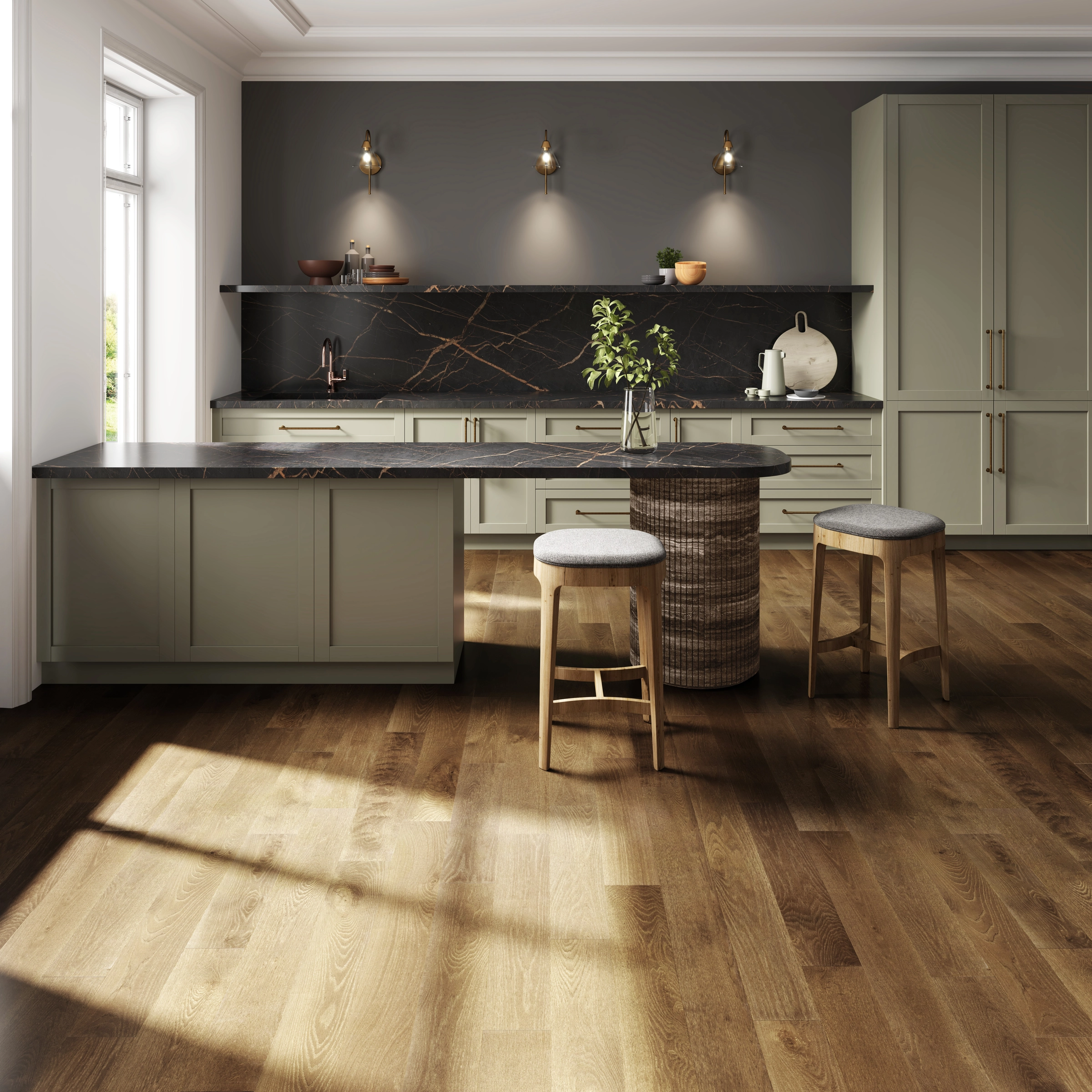
Stand in front of a laminate sample and an engineered hardwood sample from three feet away and you may not be able to tell them apart. Both show wood grain, both come in wide planks, both promise durability, and both cost far less drama than solid hardwood on the slab foundations that fill Upland, Ontario, Rancho Cucamonga, and Fontana. That surface-level similarity is exactly why the choice trips people up: the two floors look like cousins but behave like different animals, and the right pick depends less on the sample board than on your household, your budget horizon, and how you feel about walking on real wood versus a brilliant picture of it.
This guide settles the laminate-versus-engineered-hardwood question the way our showroom team settles it every week — not by declaring a universal winner, but by matching each floor to the job. You will find tools you can actually use: a priority matrix that shows which floor wins for what matters most to you, a spill simulator that tells the honest water story, and a value-over-time slider that explains why one of these floors can outlive the other by decades. The fundamentals for each category live on our hardwood information page and our laminate information page; this is the head-to-head, written for our foothill climate and our slab-heavy housing stock.
What Each One Actually Is
Before you can choose between them, it helps to retire the myths. Neither of these floors is what its reputation says. Engineered hardwood is not a lesser, fake version of solid wood, and laminate is not the flimsy, peeling product your parents complained about in the 1990s. Both categories have been reinvented, and the modern versions are what fill our showroom walls.
Engineered Hardwood: Real Wood, Rebuilt for Stability
Engineered hardwood is real hardwood — the top layer is a genuine veneer of oak, hickory, maple, or European white oak, the same species and grain you would get in a solid plank. What changes is everything beneath that surface. As our hardwood guide explains, engineered planks are built from multiple layers of wood cross-layered and bonded together, with the real wood veneer on top. That cross-layered core is the whole point: it resists the swelling and shrinking that solid lumber suffers when temperature and humidity swing, which is precisely why engineered construction has become one of the fastest-growing categories in flooring and the preferred wood for California homes built on concrete slabs. The surface you walk on is wood. The engineering underneath is what lets that wood live happily over a slab in a dry-summer, Santa-Ana-fall climate.
Because the top is real wood, engineered hardwood carries wood’s signature advantages: the depth and variation that only a natural material has, the resale line that says “hardwood floors” on a listing, and — with thick enough veneer — the ability to be refinished down the road. It comes in the looks defining this decade: wide planks, long boards, matte and low-gloss finishes, wire-brushed textures, and pale European white oak tones. Browse the full range in our hardwood collection.
Laminate: A Photograph of Wood, Engineered for Toughness
Laminate is a different idea executed extremely well. A modern laminate plank is a high-resolution photographic image of wood, sealed under a clear, hardened wear layer, all fused onto a dense fiberboard core. It is not wood, and it does not pretend to be under a microscope — but that hardened wear layer is why laminate shrugs off scratches, dog claws, dragged barstools, and dropped toys better than almost anything else in its price range. Our laminate information page describes it plainly: multi-layered synthetic construction fused in a lamination process, making it durable, resistant to scratches and everyday wear, water-resistant, and genuinely recommended for homes with pets or kids.
Laminate has two more practical superpowers. It installs as a floating floor — planks click together and rest over the subfloor rather than gluing or nailing down — which makes it fast to install and means a damaged board can often be swapped out without redoing the whole room. And, cared for reasonably, it delivers a 15-to-25-year lifespan at a friendly price. See the current styles in our laminate collection.
Round by Round: Match Your Priority
There is no floor that wins every category, so the honest way to choose is to decide what matters most in your home and see which contender takes that round. Pick your top priority below and watch the two fighters’ fit scores respond. The verdicts are the same ones our design consultants give across the counter.
Photographic wood image over a tough core — the durability-per-dollar champion.
Real wood veneer over a stability core — genuine hardwood, slab-friendly.
Real wood and resale value: engineered hardwood is the genuine article, and buyers know it. Laminate looks superb but does not carry the words “hardwood floors” on a listing.
The Water Question, Answered Honestly
Water is where marketing gets loudest and the truth gets fuzziest, so let us be precise. In the Inland Empire, day-to-day humidity is low, which is friendly to both floors. The real water question is about spills and accidents, and here the two floors have genuinely different stories. Pick a scenario and read what actually happens — no exaggeration in either direction.
Laminate
No problem. A glass of water wiped up promptly leaves modern water-resistant laminate completely unbothered. This is laminate’s home turf — sealed wear layer, everyday spills, easy cleanup.
Engineered Hardwood
Also fine. A promptly wiped spill is a non-event for a factory-finished engineered floor. Wood likes prompt cleanup, and a quick wipe never reaches the seams.
Verdict: a tie. For the spills that actually happen most, both floors win.
Laminate
Standard laminate is water-resistant, not waterproof — an accident that sits for hours can work into the seams. This is exactly why manufacturers now make waterproof-rated laminate with sealed joints; ask us about the 72-hour water-resistant and fully waterproof lines.
Engineered Hardwood
Real wood does not love an overnight puddle. A prompt discovery is fine; a long-sitting accident can mark the finish or reach a seam. For pet-heavy households, this is a real consideration in the wood-versus-laminate math.
Verdict: advantage waterproof-rated laminate — the reason so many pet owners choose it. See our laminate options.
Laminate
A sustained appliance leak is a hard test for any floating floor. Waterproof laminate with sealed joints buys you real protection time; standard laminate can swell at the core if water pools undetected. Fast discovery matters.
Engineered Hardwood
A major undetected leak is tough on real wood, as it is on almost every floor. The upside: individual engineered planks can be replaced, and the surrounding floor usually survives once the source is fixed and the area dries.
Verdict: no floor loves a hidden flood — but this is where a coordinated plan (waterproof surfaces in the wet rooms) earns its keep.
The Long Game: Value Over the Years
Upfront price is the number everyone quotes, but the number that actually matters is cost over the years you will own the floor. This is where the two floors separate most, because only one of them can be renewed. Slide through the ownership horizon and watch the difference emerge.
Over ten years, both floors look great and hold value well. Laminate has likely cost less overall; engineered wood is building the case that pays off later.
Underfoot, Underlayment, and Installation Day
Both of these floors commonly install as floating or glue-down systems over an Inland Empire slab, and both are far less invasive than nail-down solid hardwood. But the installation details differ in ways worth knowing before the crew arrives.
Laminate is almost always a floating floor: planks click edge-to-edge over a thin underlayment pad, with expansion space left around the perimeter so the floor can breathe with the seasons. That floating design is why laminate goes down fast and why a single damaged board can be replaced later. The trade-off is that the subfloor must be flat — a floating floor telegraphs high and low spots — so our installers check and correct flatness as part of normal prep.
Engineered hardwood offers more options: it can float over an underlayment like laminate, or it can be glued directly to a prepared slab for the most solid, quiet underfoot feel. Glue-down is the premium approach on concrete and the one we most often recommend for a true-hardwood result. Either way, the slab gets moisture-tested first, because concrete breathes and manufacturer warranties care about the readings. All of this is standard in our installation process, and both product types are covered by our one-year labor warranty plus the manufacturer’s coverage.
One more practical note for the DIY-curious: because laminate floats and clicks, it is the friendlier of the two for a homeowner install — and for those who want to buy material and install themselves, we offer direct purchase flooring. Engineered glue-down, by contrast, rewards professional installation and slab prep.
Where Each One Wins in an Inland Empire Home
After more than thirty years of matching floors to foothill households, the pattern is clear. Neither floor is “better” — each has rooms and lifestyles where it is obviously right.
Choose Engineered Hardwood When…
Reach for engineered hardwood when you want real wood underfoot and are thinking in decades. It is the right call when resale value matters, when you love the depth and warmth only genuine wood delivers, and when you might want to refinish the floor years from now to reset its life. It suits the main living spaces of a home you plan to keep — the great room, the formal areas, the primary bedroom — and it shines in the open plans of newer Rancho Cucamonga and Eastvale construction, where wide-plank wood calms a large room. If you own a raised-foundation home in older Claremont or Upland, engineered also plays nicely alongside any existing solid wood. Start with our engineered hardwood overview, then walk the samples in person.
Choose Laminate When…
Reach for laminate when toughness-per-dollar leads your list. It is the right call for the busiest households — big dogs, active kids, roommates, a stampede of daily life — because the hardened wear layer laughs off the scratches and scuffs that mark real wood. It is the smart pick for a rental or a flip where durability and budget matter more than the resale word “hardwood,” and, in its waterproof-rated versions, it is a favorite for pet owners. Because it installs fast and floats over the slab, it is also the value leader for whole-home projects on a budget. Explore current looks in our laminate collection and read the laminate care and advantages guide.
Coordinating Both — and Paying for It Sensibly
Here is a secret from the showroom floor: you do not have to choose just one. Many of our favorite projects run engineered hardwood through the formal living spaces and a durable laminate (or waterproof plank) in the hardworking or wet-adjacent rooms, all coordinated to one tone story so the transitions disappear. The trick is planning the tone match and the transition details at the measure, not after installation — which is exactly what our in-house design consultants do. Audition combinations in your own rooms with the room visualizer, then confirm with free samples under your actual lighting.
On budget: whichever way you lean, the payment can breathe. We offer 12-months-same-as-cash financing when available, which turns a whole-home floor into a manageable plan. In a hurry for an escrow close, a rental turnover, or a holiday deadline? Ask about quick-ship products that skip the special-order wait. And every path ends the same reassuring way: professional installation backed by our labor warranty and the manufacturer’s coverage.
The Look Factor: Wide Planks and Modern Tones
One reason this comparison is so close is that both floors now chase the same fashionable looks, and both do it well. The defining hardwood and wood-look trend of the decade is scale: wide planks and long boards that calm a room with fewer seams and a more architectural feel, exactly the effect that suits the open floor plans of newer Inland Empire construction. Engineered hardwood delivers those wide planks in genuine wood, including the European white oak and pale natural tones leading current design, as our hardwood page describes. Laminate reproduces the very same looks — wide, long, matte, and wire-brushed — through high-resolution printing and embossed texture, at a friendlier price.
Tone tells a similar story. Both categories run from light naturals to deep, rich browns, and in our intense foothill light the lighter tones do double duty by flattering the brightness and forgiving the dust between cleanings. The practical upshot for shoppers is freeing: you can usually get the look you love in either material, which means the look rarely has to be the deciding factor. That frees you to choose on the things that genuinely differ — real wood versus scratch-proof toughness, refinishing future versus lowest upfront cost — while getting the wide-plank, low-sheen aesthetic either way. Audition tones for your rooms in our visualizer before you decide.
Reading the Spec Sheet Like Our Team Does
Once you have narrowed to a category, the product label becomes the tiebreaker, and a few lines matter most. On engineered hardwood, look at veneer thickness — a thicker wear veneer is what makes future refinishing possible, the feature that separates heirloom-grade engineered from purely decorative versions — and at the finish system, since many engineered floors arrive factory-finished with aluminum oxide or UV-cured coatings for added scratch resistance, as our hardwood page notes. On laminate, look at the wear-layer rating (the abrasion class, which tells you how hard the surface will fight scratches), the core density, and whether the line is water-resistant or fully waterproof with sealed joints. None of this requires memorization — it is what our consultants translate daily — but knowing the vocabulary turns a confusing wall of samples into a confident shortlist.
Frequently Asked Questions
Is engineered hardwood better than laminate?
Can both go over a concrete slab in the Inland Empire?
Which is more waterproof?
Can laminate be refinished like wood?
Which one adds more to my home’s resale value?
Where can I compare them in person near me?
See Both, Side by Side, in Upland
The fastest way to end the laminate-versus-engineered debate is to stand on both. Bring your priorities — the household, the rooms, the budget horizon, whether you are staying or selling — to either Perry Floors showroom, and our family-owned team will translate them into a confident recommendation and a measured estimate. The reviews tell the story of how we do it, and the work gallery shows the results in real Inland Empire homes. Your right floor is a conversation away.
Laminate or engineered hardwood — let’s match the floor to your home, not the other way around.
Request Your Free Estimate


