

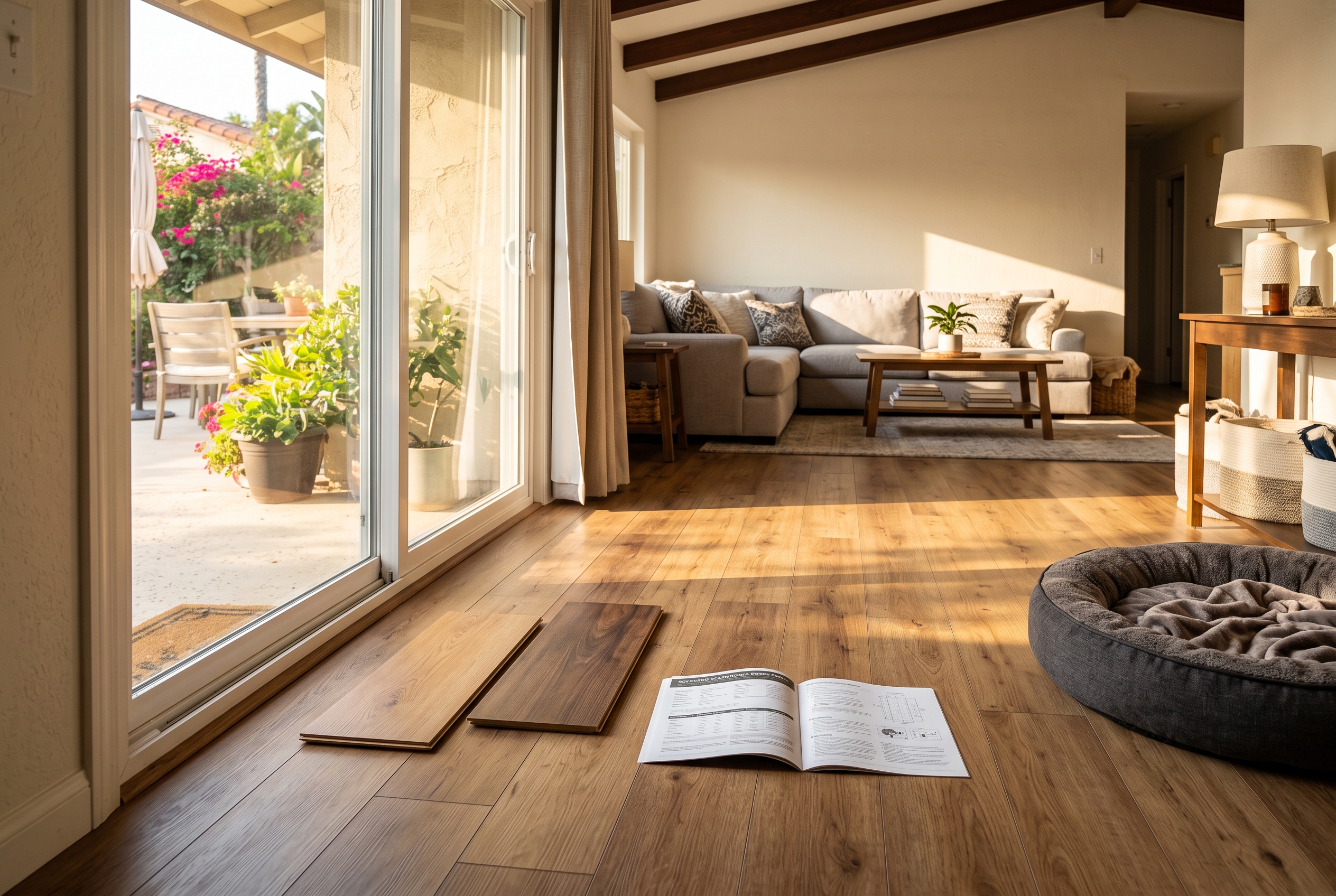
The AC rating on a laminate box is its abrasion class. It is a number from 1 to 6 that tells you how long the printed wood pattern holds up under a standard sanding test before it wears through. In a house, AC3 is enough for bedrooms and quiet living rooms, AC4 handles every room including the kitchen, the hall and the dog, and AC5 and AC6 are commercial grades most homes never need.
Thickness is a different number, usually 8 to 12 millimeters. It changes how the floor feels, how it sounds and how it takes a dropped pan, but not how long the surface lasts. The rest of the spec sheet, from the water rating to the attached pad, tells you where the plank can go.
What the AC Rating on Laminate Actually Measures
The AC rating measures how well the clear top layer of a laminate plank stands up to grit before the printed pattern underneath starts to wear away. It comes from EN 13329, a standard written for laminate in Europe, and the test behind it is easy to picture.
A square cut from the plank spins under two small wheels wrapped in sandpaper. The lab counts the turns until the first spot of the printed design wears through, the moment the Association of the European Producers of Laminate Flooring (EPLF) calls the initial point. A plank that takes more turns lands in a higher class.
At home, that same wear shows up as a grey or washed-out patch where the pattern used to be. You see it first in front of the sink, at the back door and down the middle of the hall, because grit gets ground in there by shoes and paws. A higher class keeps the pattern longer under the same traffic.
What the AC number doesn't tell you is whether water can get into the seams, how deep a dog's claw can scratch or how well the plank handles a dropped cast-iron pan. EN 13329 tests each of those on its own, and you'll find the results elsewhere on the box: in the two-digit use class on European packaging, in the certification level on many North American floors, and in the water rating on the spec sheet.
Which AC Rating Each Room Needs
If your laminate will run through several rooms as one floor, which is how most laminate goes in, choose the class for the busiest room it reaches. A bedroom floor that continues into the hall takes the hall's traffic at the doorway. A living room that opens onto the kitchen takes the kitchen's grit.
| Class | Where it fits in a house | In our catalog |
|---|---|---|
| AC1, AC2 | Light use only | None |
| AC3 | Bedrooms, a quiet living room | A few designs |
| AC4 | Every room, kitchen and dogs included | Most rated lines |
| AC5 | Sandy entries, a home office with clients | None listed |
| AC6 | More than a house needs | One line |
AC4 sits where it does on that scale for a reason. It covers a whole busy house without the price of a commercial plank, and most of the rated laminate in our catalog is AC4, across 35 lines and more than 200 colors.
European boxes often show a second number as a small picture of a house or an office: the use class. Classes 21, 22 and 23 are for homes, from moderate use such as a bedroom to heavy use such as a stairwell, and 31 to 34 are for commercial traffic. A use class takes more than abrasion to earn, so a 32 or 33 on the box means the floor was rated for shops and offices.
Is AC3 Laminate Good Enough?
Yes, AC3 laminate is good enough for bedrooms, closets, a guest room and a living room in a quiet house. Those rooms see normal family traffic, mostly in socks, which is the use AC3 is rated for.
Where AC3 runs short is the path grit takes: the back door, the kitchen work zone and the hall every room opens onto. Those are the places the pattern greys first. If your floor runs as one continuous room from the entry to the bedrooms, it takes the entry's wear along its whole length.
To tell which case you're in, picture where the floor stops. If a doorway or a change to carpet or tile closes it off in a bedroom wing, AC3 suits it. If it flows past the kitchen or the front door, buy the class those rooms need.
Is AC4 the Right Rating for Dogs and Kids?
Yes, AC4 is the right rating for a house with dogs and children, because it holds its pattern under the grit they track in from the yard. What AC4 can't promise is that a dog's nails won't mark it. A claw scratches by pressing hard on one spot, a different kind of wear from the grinding the AC test measures.
Texture and trimmed nails do more against claws than a higher class. A textured, embossed surface hides small scuffs and shed hair far better than a smooth one, and a mid-tone color hides more than very light or very dark.
A sloshing water bowl or an accident left overnight is a water problem, not a wear problem, so the plank's water rating is what protects you there. On dry, windy days here, fine sand blows in through every open door. A mat inside and outside the door the dog uses does as much for an AC4 floor as anything printed on the box.
When AC5 or AC6 Is Worth It in a House
If part of your house takes commercial-style traffic, AC5 or AC6 laminate earns its price. That means a home office where clients walk in from the street, an entry from a pool deck, a garage that tracks in sand, or a rental that turns over with every lease. For a family home, AC4 already covers the busiest kitchen and hall.
You may read that AC5 laminate feels rougher underfoot. The class is a wear test and sets no texture, so the feel comes from the design the maker chose. Stand on a sample in socks and compare it with an AC4 plank in a similar texture before you decide.
AC6 is the top of the scale. We carry one AC6 line, TRUCOR's Tymbr XL, and it suits a space with shop-level traffic. In a house, it mostly buys peace of mind at a higher price.
Why Some Laminate Boxes Show No AC Rating
Many laminate floors sold in North America carry no AC rating because the North American Laminate Flooring Association (NALFA) certifies laminate to its own standard, LF-01, which doesn't use AC classes. NALFA certifies a floor to one of four levels: Residential, Light Commercial, Commercial or Heavy Commercial.
LF-01 is a broader test than the AC class. A floor has to clear minimums in 14 categories, including impact, stains, castor chairs, heavy loads, fading and how much the core swells in water. Its wear test uses the same kind of sandpaper wheels as the European one, and the Heavy Commercial level asks for four times the wear resistance of the Residential level. It also requires the floor to meet the federal and California formaldehyde limits.
Some makers print no class at all on their product pages. Mohawk's RevWood Plus and Mannington's Restoration Collection, both lines we carry, list their thickness, wear coating and waterproof system with no AC number beside them. Both are built for busy homes, so a missing number isn't a warning sign.
When the box shows no AC rating, read three other lines instead. Look for the NALFA certification mark. Look at the wear coating and water system the maker lists. And read the residential warranty, which on laminate is written around the printed pattern wearing through under normal household use.
Why an AC Rating and a Vinyl Wear Layer Don't Convert
An AC4 laminate has no wear layer thickness you can compare with vinyl, because laminate's wear layer is graded by a test, not measured. The top of a laminate plank is a thin sheet of melamine resin loaded with aluminum oxide, a hard mineral, which is what lets it shrug off grit. The AC class says how long that sheet lasts.
Vinyl plank works the other way. Vinyl's wear layer is a clear layer measured in mils, often around 20 on thicker planks, and more mils means a longer life. No formula turns a mil count into an AC class, since one is a thickness and the other is a test result.
To compare the two, compare the room advice instead of the numbers. An AC4 laminate and a 20 mil vinyl plank are both whole-house floors for a busy family. An AC3 laminate and a 12 mil vinyl are both comfortable in bedrooms. Then let water settle the choice, since that is where the two floors really differ.
What Laminate Thickness Changes, and What It Doesn't
A thicker laminate plank feels more solid, sounds less hollow and takes a dropped object better. It adds impact resistance, stability and quieter footsteps, and a thinner plank still performs well on the right underlayment. Surface wear stays the AC class's job.
Laminate runs from about 6 to 12 millimeters, with a few thicker planks. Read how the number is written, because some makers count the pad. Pergo lists its Elements Birkhall Landing as 8 mm plus a 2 mm attached pad, while Mannington's Restoration Collection is 12 mm with no pad, so it goes over a separate underlayment. A 10 mm plank with its pad can still be thinner than a 12 mm plank without one.
A thicker plank bridges small dips in the subfloor more easily, but it doesn't excuse a subfloor that isn't flat. The installation instructions for each floor set the limit, and for its RevWood, Mohawk allows no more than 3/16 inch of unevenness over 10 feet. Over a concrete slab, which is what most houses here sit on, NALFA calls for a slab cured at least 90 days, a 6-mil vapor barrier and an underlayment pad.
An attached pad doesn't replace that barrier on concrete. The same RevWood instructions start with a plastic vapor barrier over the slab, seams overlapped 8 inches or more, even when the pad comes attached to the plank. Upstairs over plywood, the plank's thickness and the pad matter most for sound, because footsteps carry into the room underneath.
8mm, 10mm or 12mm Laminate for Each Room
For most of a house, 10 mm laminate is the comfortable middle thickness. A 12 mm plank is worth it where hollow sound or dropped pans bother you, and 8 mm on a good pad suits bedrooms and is the easiest on door clearances.
| Thickness | Feels like | Best for | Watch for |
|---|---|---|---|
| 8 mm | Light; needs a good pad | Bedrooms, upstairs rooms | Hollow sound on a thin pad |
| 10 mm | Solid underfoot | Living areas, most homes | Little; the common choice |
| 12 mm | Closest to real wood | Kitchens, open main floors | Door and dishwasher heights |
Where rooms meet at a doorway, keep one thickness if you can, even when the classes differ. Floors of the same height meet flush, while two different heights need a transition strip to step between them.
How a Thicker Plank Changes Door, Stair and Appliance Heights
A thicker plank raises the floor by its own thickness plus the pad's, and that changes door clearances, the dishwasher opening and the top stair. A 10 mm plank on a 2 mm pad sits about half an inch above the subfloor, so check these places before you order.
- Doors. Swing each door that crosses the new floor over a scrap of plank and pad stacked together. A door that drags gets trimmed at the bottom.
- The dishwasher. Measure from the subfloor to the underside of the countertop. A new floor that runs into the dishwasher opening can trap the machine, so leave room to pull it out.
- Stairs. The stair nose at the top step has to match the plank's thickness, so choose it from the same line as the floor.
- Transitions. Where laminate meets tile or carpet, the strip between them covers the height difference, and a thicker plank can need a different profile.
A thick plank is still a good choice. Checking these spots before the boxes arrive is what keeps it from becoming a surprise on installation day.
The Other Numbers on a Laminate Spec Sheet
Wear is only one line on a laminate spec sheet, and the rest cover water, comfort and looks. AC4 is not a water rating, and a waterproof plank isn't automatically AC4, so read each line for what it says.
Water comes first if the floor goes near a sink, a dishwasher or a dog bowl. Waterproof systems such as Mohawk's WetProtect and Mannington's SpillShield Plus seal the surface and the joints so standing water stays on top. Water-resistant laminate, sometimes labeled topical moisture protection, handles everyday spills that get wiped up. Water-resistant and waterproof laminate are different products, and for a kitchen, a laundry room or a house with a water bowl, eleven of the laminate lines we carry are rated waterproof.
Most laminate is built on high-density fiberboard (HDF), wood fibers pressed under heat. A denser core holds the locking edges tighter and resists swelling at the seams.
If the spec says the underlayment is attached, it will also give the pad's thickness. An attached pad saves a step, and the right pad supports the locking edges and evens out minor bumps.
Texture matters more than it looks. Embossed in register (EIR) means the texture follows the printed grain, so the knots and grain lines feel real, and it hides scuffs. A pressed or painted bevel along the edges makes each plank read as a separate board, the way real wood does.
Before you buy a steam mop, check the care line for your floor. Mohawk says its RevWood Plus Hampton Villa is safe for steam mopping, and Mannington approves residential steam cleaners on its Restoration Collection, but not every laminate allows it.
A FloorScore seal means the floor was tested for indoor air quality, and an emissions seal on a laminate box is worth reading if anyone in the house is sensitive. The residential warranty tells you how long the maker stands behind the pattern under normal use. The paperwork that comes with your floor is what counts, and we go through it with you before you order.
Choosing the AC Rating and Thickness for Your Home
Most homes here are one- or two-story houses on a slab with an open main floor, so the usual answer is one AC4 floor through the main level. The table shows how the class, the thickness and the water rating line up for the homes we see most.
| Your home | AC rating | Thickness | Water rating |
|---|---|---|---|
| One floor through a busy main level | AC4 | 10 or 12 mm | Waterproof |
| Bedrooms closed off by doors | AC3 or AC4 | 8 mm on a good pad | Water-resistant |
| Kitchen with a dishwasher | AC4 | 10 or 12 mm | Waterproof |
| Dogs or small children | AC4, textured | 10 or 12 mm | Waterproof |
| Rental that turns over | AC4 or AC5 | 10 mm | Waterproof |
| Home office or sandy entry | AC5 or AC6 | 10 or 12 mm | Waterproof |
If two rows fit your house, take the tougher one for the rooms they share. A kitchen in a dog household needs both the waterproof line and the textured AC4 surface. A rental gets the waterproof line too, because you won't be there when the dishwasher leaks.
You can mix classes from room to room as long as each floor ends at a doorway or a transition. If the budget is tight, AC4 waterproof in the kitchen, entry and hall with AC3 in closed-off bedrooms is a sensible split. Keep the thickness the same throughout so the floors meet flush and the house doesn't feel patched together.
Spend where the traffic and the water are. A tougher plank pays off at the sink and the back door every day, while in a guest room it mostly sits.
What AC4 and Thicker Laminate Cost
Nationally, laminate costs about $3 to $13 a square foot installed, with labor about $2 to $8 of that, in HomeAdvisor's survey of more than 10,000 customers. The AC class and the thickness move the material price, not usually the labor, because a click-together plank goes down the same way at any rating.
| Plank | Material per sq ft | For 500 sq ft |
|---|---|---|
| 8 mm | About $1 to $1.80 | About $500 to $900 |
| 10 mm | About $2 to $4 | About $1,000 to $2,000 |
| 12 mm | About $2.30 to $6 | About $1,150 to $3,000 |
A tougher plank adds about $1 to $3.50 a square foot by the same survey, and a separate underlayment runs about $30 to $60 per 100 square feet when the pad isn't attached. On a 500 square foot main floor, the step from an 8 mm plank to a 12 mm AC4 waterproof one can be $1,000 or more in material alone. Texture moves the price too: the same survey puts smooth laminate at about $1.70 to $2.60 a square foot and hand-scraped looks at about $3 to $6.
Prep under the floor, stairs and trim add to any installed price, and on many jobs they move the total more than the plank does. That is why two quotes for the same plank can differ by more than the plank's whole cost.
Why Laminate Looks Worn Too Soon, and What Fixes It
If your laminate already looks tired in places, grit is the likeliest cause. Sand and dirt act like the sandpaper in the AC test, and they collect where people turn and stop: at the sink, the back door, the end of the sofa. Laminate can't be sanded, waxed or refinished, so the fix is to stop the grit: a mat inside every exterior door as well as outside it, and a sweep or vacuum before grit gets ground in.
Fine scratches in one spot come from point pressure: a dog's nails, a chair leg, a pebble under a shoe. Felt pads under every chair and table leg stop most of it, and rubber casters in place of plastic ones stop the rest. For small dings and chips on its planks, Pergo makes a color-matched Finishing Putty.
A chipped edge comes from a hard hit, usually a dropped pan or an appliance pulled out without a board under it. A small chip takes putty; a large one means replacing the plank. Because laminate floats, a damaged plank can be replaced without redoing the floor, and the planks between the wall and the damaged one come up and click back in.
Raised or swollen seams mean water, not wear. A spill or a slow leak has reached the core at the joints, and fiberboard that swells doesn't shrink back. Stop the source, let the area dry, and replace the swollen planks.
A hollow click or a soft spot underfoot means the subfloor isn't flat there, and the plank is flexing over a dip. That one is fixed by lifting the planks and leveling the low spot, not by a new plank.
AC4 Laminate at Perry Floors
At Perry Floors, we carry 94 laminate lines in more than 500 colors, and most of the rated ones are AC4. They include Pergo's Elements collections, Mohawk's RevWood, Mannington's Restoration Collection and TRUCOR's Tymbr lines, and you can filter them by AC rating, water protection and attached pad. Order a few samples and lay them on your floor for a couple of days. You can also see our floors in person at either of our Upland showrooms, on North Mountain Avenue and on West 9th Street.
If you need the floor soon, our Quick Ship laminates are locally sourced and generally available the next business day, with pickup usually within 48 hours depending on the maker's stock. We install the laminate we sell with licensed installers, and every installation carries our one-year labor warranty on top of the maker's coverage.
If you'd rather install it yourself, you can buy the floor directly from us and pick it up from the maker or have it shipped to our warehouse for a small fee. Either way, you can spread the cost over months. For an installed floor, we price your rooms at a free in-home estimate, where your subfloor and the layout of your rooms show up in the number.
Questions People Ask About Laminate AC Ratings
What AC Rating Do Laminate Stairs Need?
Because every step is walked in the same spot, especially the front edge, laminate stairs need AC4 at least. EPLF's own example of heavy home use is a stairwell, and a staircase in a busy house wears faster than any room it connects.
The stair nose matters as much as the class. It has to match the plank's thickness and finish, so it should come from the same line as the floor, and it takes the hardest wear on the whole staircase.
Does a Higher AC Rating Mean a Longer Warranty?
No, not automatically. Each maker sets its own warranty terms line by line, so two AC4 floors can carry different wear warranties. Laminate wear warranties are written around the printed pattern wearing through under normal household use, which is what the AC class measures, so the two point at the same thing without being tied together.
Read the water coverage separately from the wear coverage, because a maker can cover the two differently on the same floor. The paperwork with your floor is what counts.
Is the AC Rating Printed on the Plank?
No. The AC rating is printed on the box, the maker's spec sheet and the product page, not on the plank itself, so once the boxes are gone it has to be looked up.
If you're trying to learn the rating of a floor you already have, the brand and the line name are what lead back to it. With those, the maker's spec page will show the class, or the certification level if the maker uses that instead.
Is Laminate Slippery for Dogs?
Yes, a smooth, glossy laminate can be slippery for a dog, and the AC rating won't warn you, because it doesn't measure grip. Slip resistance isn't part of the AC test or of the certification tests, which list it only as an optional extra a maker can report.
For a dog, texture is what helps. A textured, low-gloss surface gives paws more grip than a glossy one. A runner on the routes the dog races down, such as the hall and the turn into the kitchen, helps an older dog most.
See AC4 Laminate in Your Own Light
Once you know the class and the thickness your rooms need, the last choice is the one a spec sheet can't make: how the plank looks in your light, next to your cabinets and walls. Bring a few samples home and live with them for a few days. When you've picked one, we measure your rooms and price the floor you chose.


