

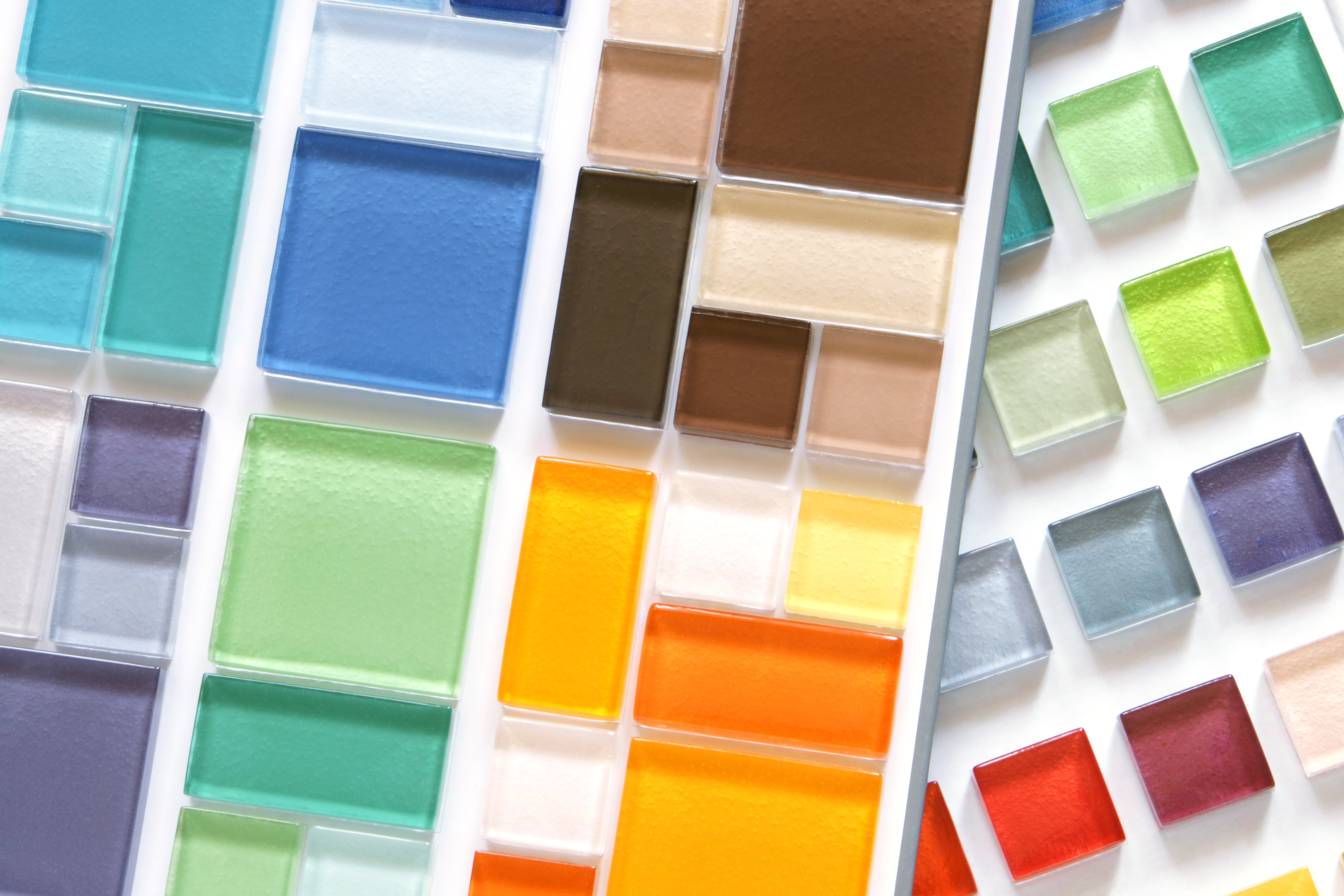
Walk past the glass tile displays in either of our Upland showrooms and you will see people do the same thing every time: reach out and touch. Glass tile has a depth that ceramic and porcelain simply cannot copy, because light does not stop at the surface — it passes into the tile, bounces off the back, and comes out glowing. In a region like the Inland Empire, where intense Southern California sun pours through kitchen windows in Rancho Cucamonga and slider doors in Eastvale, that light-play is not a small detail. It is the whole reason to choose glass.
This guide walks through where glass tile earns its keep — backsplashes, shower accent bands, niches, and feature walls — and where it honestly does not belong. We will cover why glass behaves differently from ceramic, why your grout color choice matters twice as much with glass, how mosaic sheets differ from larger-format glass, and why glass is the one tile category where we push hardest for professional installation. You can browse all 73 products in the Perry Floors glass tile catalog online, or come see them in person, because glass is the tile that photographs worst and looks best in real light.
Why Glass Tile Behaves Differently From Ceramic and Porcelain
Ceramic and porcelain tile are opaque. Light hits the glaze, reflects off the surface, and that is the end of the story — what you see is a printed or glazed face. Glass is translucent. Light enters the tile body, refracts, bounces off whatever is behind the tile, and exits again. That round trip is what gives glass its liquid, dimensional quality, and it drives three practical consequences worth understanding before you buy.
First, glass shows what is behind it. Because light passes through the tile, the color of the setting material telegraphs through to the finished wall. Install a translucent aqua glass mosaic over gray thinset and the whole wall reads darker and muddier than the sample you loved. This is why glass tile is almost always set in bright white thinset — and why trowel ridges, if they are not flattened properly, can show as faint stripes behind the tile forever. No ceramic tile in our tile catalog has this issue; hundreds of glass products do.
Second, glass is non-porous. Glazed ceramic is quite stain-resistant, but glass takes it further: the material itself absorbs essentially nothing. Tomato sauce, turmeric, red wine, cooking oil — nothing penetrates a glass tile face. That makes glass one of the most genuinely stain-proof surfaces you can put behind a range. The grout between the tiles is still the vulnerable spot, which is why the grout section below matters so much.
Third, glass reflects light rather than absorbing it. A glass backsplash bounces daylight deeper into a kitchen and makes under-cabinet lighting look roughly twice as effective. In mid-century ranch homes around Upland, Ontario and Claremont — where kitchen windows are often smaller than in newer builds — that borrowed brightness is a real, functional upgrade, not just a style choice.
The glass swatch already shows a moving highlight; the ceramic shows its printed color and nothing more.
Why it happens: glass is translucent, so light travels into the tile, bounces off the reflective back and the thinset behind it, and exits again. Ceramic glaze is opaque — light reflects once off the surface and the color never changes character.
The chip demo above is the physics in miniature. It is also why we tell homeowners in Fontana and Corona to look at glass samples at home, at different times of day, before committing. Perry Floors offers free shipping on samples through the online catalog precisely because glass changes so much between showroom lighting and your actual kitchen.
Where Glass Tile Belongs in Upland and Rancho Cucamonga Homes (and Where It Does Not)
Here is the honest map. Glass tile is superb on kitchen backsplashes, where its stain-proof face and light reflection do real work. It is excellent on shower walls as accent bands, niche interiors, or even full feature walls, because glass shrugs off water and soap. It is a natural for powder room and entry feature walls, where a small square footage of dramatic material delivers a big impression.
Where glass does not belong, in most homes, is on the floor. Two reasons, and we would rather tell you now than after a slip. First, traction: standard glossy glass tile is slippery when wet, and most glass products do not meet the DCOF 0.42 threshold that the ANSI standard sets for level interior floors that get wet. Second, scratches: glass shows fine surface scratches far more visibly than porcelain, and on a floor, grit acts like sandpaper underfoot. There are textured, slip-rated glass mosaics made specifically for shower floors and pool waterlines, and the small grout-joint grid of a mosaic adds grip — but they are the exception, and they need to be selected deliberately. For most floors, porcelain or natural stone remains the right call; our tile flooring guide covers what makes a floor-rated tile.
Notice the pattern in those verdicts: glass wins on vertical surfaces and loses on horizontal ones. Keep that one rule in mind and nearly every glass tile decision gets easier. You can see how homeowners across the area have used tile in real projects in the inspiration galleries — real rooms, not staged catalog shots.
Mosaic Sheets vs Larger-Format Glass
Most glass tile sold today comes as mosaic sheets: small pieces — squares, subway shapes, hexagons, linear strips, penny rounds — face-mounted on a mesh backing, usually in sheets around twelve inches square. The mesh holds the spacing for you, sheets cut easily around outlets and windows, and the many small pieces wrap the slight waviness of real walls gracefully. Mosaics also mix materials well: many of the most popular sheets blend glass with stone or metal accents so the shimmer is built in without reading as a wall of mirror.
Larger-format glass — glass subway tile in three-by-six or four-by-twelve sizes, and bigger panels — delivers a sleeker, calmer look with far fewer grout lines. The trade-off is that big glass is far less forgiving. Every ripple in the wall telegraphs through a large reflective face, thinset coverage must be near-perfect to avoid visible voids and shadows behind the tile, and cutting large glass cleanly requires experience and the right wet saw setup. If a crisp, minimal glass subway backsplash is the goal, budget for expert installation; it is the difference between glossy and wavy.
Pattern choice matters as much as piece size, and glass rewards some layouts more than others. Because every edge of a glass tile catches light, the layout you choose is drawn on the wall in tiny highlights.
Grout Color Strategy: The Choice That Counts Double With Glass
With ceramic tile, grout color is a supporting actor. With glass, it plays two roles at once. The first is the familiar one: grout lines either outline each tile (contrast) or dissolve into the field (blend). The second is unique to glass: because the tile edges are translucent, the grout color glows through the sides of every tile, subtly tinting the whole installation. A charcoal grout does not just outline aqua glass mosaics — it cools and deepens them. A bright white grout lightens the same sheet by a full step. The sample board never tells you this; the wall does.
Use the simulator below on the exact kind of aqua mosaic that fills so many Inland Empire kitchens and showers, then hold your favorite against your countertop and cabinet choices. If you are still assembling that palette, the guides to quartz, granite and marble countertops and the featured cabinet brands Perry Floors carries are the natural next stops.
With glass, always confirm the grout is compatible with glass tile (unsanded or fine-aggregate grouts are typical for narrow joints, since coarse sanded grout can scratch some glass faces during installation).
One more grout note that matters here more than in milder climates: our region’s municipal water is famously hard. Light grout in a shower will mineral-stain faster in Fontana, Rialto or San Bernardino than it would near the coast. If your heart is set on white grout in a wet area, plan on sealing schedules and the squeegee habit described near the end of this article.
Pairing Glass Accents With Field Tile, Countertops and Cabinets
Glass tile is a strong flavor. The installations that still look right in fifteen years almost always follow the same recipe: a calm, quality field material over most of the surface, with glass concentrated where it counts. In practice that means a porcelain or ceramic field from the main tile catalog — Perry Floors stocks over 500 tile products — carrying the walls, with a glass band, niche or backsplash zone providing the light.
Three pairing rules that hold up in real Inland Empire kitchens and baths:
- Let one surface talk. If the countertop is a dramatic veined quartz or granite, choose a quieter glass in a tone pulled from the slab. If the counter is a calm solid tone, the glass backsplash can carry the pattern. The featured countertop brands page shows the ranges Perry carries so you can build the pairing in one visit.
- Pull the glass color from something permanent. Cabinet paint changes; plumbing fixtures change. Tie your glass tone to the countertop or the field tile, the two things you will not repaint.
- Repeat the accent once. A glass backsplash feels intentional when the same glass reappears in the shower niche of the adjoining bath, or in a laundry backsplash. One echo reads designed; three reads themed.
If you are struggling to picture any of this in your own kitchen, use the free kitchen visualizer to see products rendered in a room like yours, or bring photos and measurements into the Mountain Ave. or 9th St. showroom in Upland and work through it with the in-house design consultants. Both showroom locations keep full glass mosaic boards on the floor, because this is a material you need to tilt in your hands under real light.
Accent Bands, Niches and Feature Walls in Custom Showers
Custom tile showers are where glass accents do their finest work, and they are a core service at Perry Floors — from waterproofing and pan construction to the finished glass detail. The design question is always the same: where should the glass go? There are four proven answers, and each changes the feel of the room differently.
Whichever placement you choose, insist on seeing the accent laid out dry before it goes on the wall. Mosaic sheets vary blend-to-blend, and a good installer will arrange sheets so color drifts look intentional. That kind of care is visible all over our work gallery — real Inland Empire projects, photographed as installed.
Installation: Why Glass Is the Least DIY-Friendly Tile
Plenty of confident weekend tilers have set a ceramic backsplash successfully. Glass is a different sport, and it is worth understanding exactly why before deciding to self-install:
- White thinset is mandatory, and coverage must be near-perfect. Because the tile is translucent, the setting bed is part of the finished look. Installers back-butter or flat-trowel to eliminate ridge shadows and voids — any air pocket reads as a permanent gray blotch behind the glass.
- Glass expands and contracts more than ceramic, and it does not flex. Glass has a higher thermal expansion rate than the substrate it is bonded to, so quality installs use polymer-modified mortars rated for glass and honor movement joints. In our climate — 95 to 105 degree summer stretches, cool nights, big daily swings — skipping this is how hairline cracks appear a year later.
- Crack-isolation matters. Over slab-on-grade construction, which describes most homes from Upland to Riverside, a crack-isolation or anti-fracture membrane keeps minor substrate movement from telegraphing into a rigid, unforgiving glass face.
- Cutting glass cleanly is a skill. Glass chips at cut edges far more readily than porcelain. Clean results need a wet saw with a glass-specific blade, slow feed rates, and often taped cut lines — and every chipped edge on a reflective tile is visible from across the room.
- Mistakes are expensive twice. Glass mosaic is a premium material, and failed glass cannot be quietly hidden the way a slightly imperfect matte porcelain can. You pay for the tile again and the demo besides.
This is why glass backsplashes and shower accents are installed by Perry Floors’ licensed installers, with both labor and manufacturer coverage — the details are on the labor and manufacturer warranties page. The full menu of installation and remodel capabilities, from kitchens to complete custom showers, is on the services page.
Thinking about a backsplash or shower refresh? Measurements, layout advice and honest product guidance are free — request a free in-home estimate and a real person (often Brian himself — the owner, with 40 years of flooring experience) will walk the project with you.
Cleaning Glass Tile in Hard-Water Country: Fontana, Rialto and Redlands
Day to day, glass is one of the easiest surfaces in the house: warm water, a drop of dish soap, a soft cloth. No sealing of the tile itself, ever, because there is nothing porous to seal. The one enemy is the same one that spots your shower door: hard water. Much of the Inland Empire draws mineral-heavy water, and evaporated droplets leave white calcium film that reads far more visibly on glossy glass than on matte porcelain.
The fix costs almost nothing:
- Adopt the squeegee habit. Thirty seconds with a shower squeegee after the last shower of the day prevents ninety percent of mineral spotting. Hang it in the shower so it actually gets used.
- Dissolve spots with mild acid, not abrasion. A 50/50 white vinegar and water spray, left to sit a few minutes and rinsed, dissolves fresh mineral film. Never use scouring powder, steel wool or magic-eraser-type abrasives on glossy glass — they create the fine scratches that dull it permanently. (Skip vinegar if your accent mixes glass with natural stone; use a stone-safe cleaner instead.)
- Protect the grout, not the glass. Cementitious grout is the porous part of the wall. Keep it sealed on schedule — or ask about high-performance grouts at installation time — and the whole surface stays new-looking.
- On kitchen backsplashes, wipe grease film with a degreasing dish soap before it bakes on near the range. The glass will not stain, but built-up film dulls the sparkle that made you choose it.
Homeowners consistently mention the easy upkeep in Perry Floors reviews — glass backsplashes are among the least-regretted finishes clients choose, precisely because they still look new years in.
Glass Tile Questions We Hear in the Upland Showrooms
Does glass tile fade in strong sun?
No — and this matters in our climate. Glass tile color is typically fired into or fused onto the glass itself, so it will not fade or yellow even in a west-facing Corona kitchen that takes brutal afternoon sun. It is one of the most UV-stable finishes you can install.
Is glass tile durable enough for a kitchen?
On a wall, absolutely. Glass tile is hard, water-impervious and stain-proof; its weaknesses are point impact (a heavy pot corner) and scratching underfoot — which is exactly why we recommend it for backsplashes and walls rather than counters and floors.
Can glass tile go over my existing backsplash?
Sometimes tile-over-tile is possible, but glass is the least forgiving material to do it with, since surface irregularities telegraph through. Most quality installs start with removal and a flat, properly prepared substrate. An estimator can tell you which camp your kitchen falls in during a free visit.
Do you carry glass tile locally, or is it special order?
Both. The glass tile collection runs 73 products online, sample boards live in both Upland showrooms, and a design consultant can tell you which lines are stocked closest to home when a remodel timeline is tight.
Perry Floors serves Upland, Ontario, Claremont, Montclair, San Dimas, Rancho Cucamonga, Fontana, Rialto, Redlands, San Bernardino, Corona, Eastvale, Riverside and the surrounding Inland Empire cities from two Upland showrooms — 223 North Mountain Ave and 952 W 9th St. Family-owned, one-stop, with in-house design help and licensed installation crews; the story is on the about us page.
Ready to See Glass Tile in Real Light?
Bring your countertop sample or a photo of your kitchen, tilt a few mosaic boards under the showroom lights, and get honest advice on grout, layout and installation — then let us measure it for free.
Request Your Free Estimate →


