

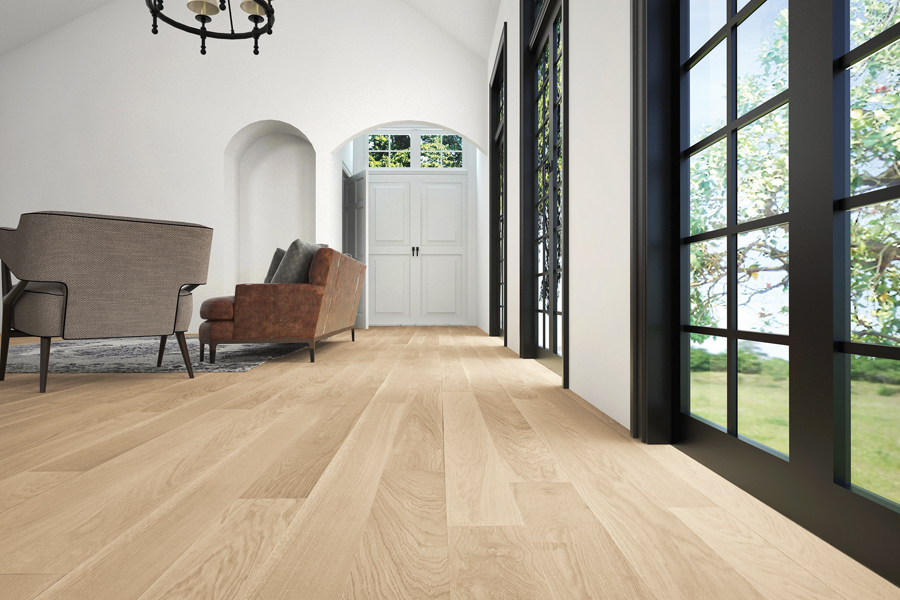
Hardwood is the floor people mean when they say “someday” — and someday arrives more often than you might think in our showrooms. It is the surface that makes a Claremont craftsman feel correct and a new Rancho Cucamonga build feel established, the one flooring category that appreciates in character while everything else just ages. And in our corner of Southern California, buying it well means answering three local questions national guides skip entirely: what does a slab foundation mean for wood, what does a bone-dry climate do to it, and what does relentless foothill sunshine ask of its finish, season after season?
This guide answers all three with tools you can play with — a foundation gate that shows which installation methods your house actually permits, a hardness arena for choosing species, a sun-fade lab, and a dry-air forecaster that explains why engineered construction has taken over Southern California wood sales. The fundamentals live on our hardwood information page; this is the local edition, written from the experience of a team that has installed wood floors in these foothill cities for over 40 years.
Start Under the Floor: What Your Foundation Permits
Wood flooring guides love to debate nail-down versus glue-down versus floating as if every home offered all three. Yours probably does not. Most homes built in Upland, Ontario, Fontana, and the surrounding cities since the 1960s sit on a concrete slab — no basement, no crawl space, no plywood subfloor to nail into. That single fact, visible from your own garage step, decides more about your hardwood project than any sample board. Flip the toggle:
Nail-down solid
The traditional method: solid planks nailed to a wood subfloor. Needs something to nail into — which a slab, by definition, is not.
Glue-down engineered
Planks bonded directly to the prepared slab: the quietest, most solid-feeling result over concrete, and the premium spec for slab homes.
Floating engineered
Planks click together over an underlayment: faster, economical, and forgiving — with underfoot feel that quality products keep impressively close to glued.
Slab-on-grade — the Inland Empire default. Solid planks nailed to plywood are off the menu; the wood conversation becomes an engineered conversation: glue-down for the most solid feel, floating for speed and economy. Slab moisture gets tested before either.
Engineered Hardwood: Real Wood, Re-Engineered for Here
Let us retire the biggest misconception in the category: engineered hardwood is not fake wood. The surface you walk on is a veneer of genuine oak, hickory, or maple — the same trees, the same grain, finished the same ways. What changes is everything beneath: layered construction that resists the expansion and contraction solid lumber suffers when humidity swings. As our hardwood guide notes, engineered has become one of the fastest-growing categories in flooring precisely because it delivers wood’s beauty with far better dimensional behavior — and today’s engineered lines carry the looks driving the market: wide planks, long boards, matte and low-gloss finishes, wire-brushed textures, and European white oak styles. Thicker veneer products can even be refinished, preserving wood’s signature long-game advantage.
For slab-country buyers the takeaway is simple: engineered construction is not the compromise option here — it is the correct tool. Solid hardwood still has its place on raised foundations and in heritage restorations, and we sell and install both; the Foundation Gate above tells you which conversation your house wants to have.
Species Selection: Enter the Janka Arena
Wood hardness is measured by the Janka test — how much force it takes to press a steel ball into the grain. You do not need the lab numbers; you need what they mean on a Tuesday: the dog tearing to the doorbell, the barstool dragged at breakfast, the toy dropped from the high chair. Pick a species and read its fight card:
Oak — the benchmark: hard enough for real family life, forgiving enough to machine and refinish beautifully. The default for a reason.
High heel / point load
Dog claws
Dragged chair
Classic grain, hundreds of finishes, and the deepest catalog: browse our oak collection — including the European white oak looks leading current design.
The Sun Tax: What 280 Sunny Days Do to a Wood Floor
Inland Empire sunshine is a lifestyle amenity and a slow-motion finishing process. UV light changes wood’s color over time — some species mellow and deepen, others lighten — and the floor near a west slider lives a different photochemical life than the hallway. None of this is damage; it is what real wood does. But it has one famous gotcha, and a rug is how you meet it. Run the years:
(never moved)
Day one: rug and floor match perfectly — one continuous tone.
Dry Air, Honest Wood: The Gap Season Forecast
National hardwood advice obsesses over humidity damage from moisture. Our problem runs the other way: Inland Empire air spends much of the year dry — Mediterranean-dry through summer, then drier still when Santa Ana winds arrive in fall. Dry air pulls moisture from wood; wood responds by shrinking ever so slightly across each plank; and homeowners notice hairline gaps between boards that close again when winter moisture returns. It is seasonal breathing, not failure — and it is the second big reason engineered construction earns its keep here. Watch the year:
January — indoor air around 52% relative humidity
Solid plank breathes with the seasons: barely-there joints in winter, visible hairlines by late summer and Santa Ana season. Normal physics — manage indoor humidity and expectations together.
Finish School: The Looks Leading the Market
If your reference image of hardwood is the glossy golden oak of the 1990s, the current showroom wall will be a pleasant shock. The looks defining this decade — called out on our own hardwood info page — are wide planks and long boards that calm a room the way large-format tile does; matte, satin, and low-gloss finishes that read refined and hide micro-scratches; wire-brushed and hand-scraped textures that make daily life invisible; and tone families running from pale natural and European white oak looks to deep, rich statements. For sunny, busy Inland Empire rooms, the fashionable choices happen to be the practical ones — texture and low sheen are camouflage, and lighter tones flatter our intense natural light. Start from a tone with the light-tone hardwood collection, or filter the full hardwood catalog by species, look, and finish the way our showroom team does.
Where Solid Hardwood Still Rules
Everything above makes the engineered case for slab homes — but solid hardwood keeps an honored kingdom here, and it maps neatly onto our oldest neighborhoods. The craftsman and vintage housing stock of Claremont, downtown Upland, and old Ontario largely predates slab construction: raised foundations, wood subfloors, and — in many cases — original solid floors already underfoot. For those homes, classic nail-down solid hardwood is not just possible; it is period-correct, and its century-scale refinishing capacity is the whole point. If your existing floors might be salvageable rather than replaceable, that restore-or-replace question deserves its own analysis — we wrote a separate guide on exactly that decision — and either way, the species and finish thinking in this article applies identically.
Solid also remains the connoisseur’s choice for above-slab installations where maximum refinishing depth matters more than dimensional calm — with the honest caveat that our dry seasons will exercise it harder than engineered construction, as the Gap Forecaster shows. Wood choice, like everything in flooring, is matching the material’s nature to the house’s reality.
Scale and Tone: Why Wide Planks Took Over
The defining hardwood look of this decade is scale: planks dramatically wider and longer than the strip flooring of past generations. The effect is architectural — fewer joints, calmer floors, rooms that read larger — and it suits the open plans of newer Rancho Cucamonga and Eastvale construction perfectly. Wide planks raise the stakes on two practical fronts, though: they show seasonal movement more readily (each board shrinks across more width — advantage engineered, again) and they demand flatter substrates, which our installers verify and correct as part of normal prep.
Tone is the other half of the current look. The orange-toned gloss of decades past has given way to naturals, pale neutrals, and European white oak character on one end, and confident deep browns on the other. In our intense natural light, lighter floors do double duty — they flatter the brightness and forgive the dust between cleanings. Audition tones in your own rooms with the visualizer, then confirm with free samples under your actual windows — wood tone is the last thing to choose from a screen.
The Acclimation Ritual (Do Not Let Anyone Skip It)
Between delivery and installation there is a quiet, unskippable step: the wood sits in your home and acclimates — adjusting its moisture content to your house’s actual environment before it is fastened down. Skip it, and a floor installed during a humid week will shrink into gaps come Santa Ana season; install bone-dry stock into a moist week and boards can press against each other later. Acclimation time varies by product and conditions; what matters is that it is planned, with material delivered ahead of the crew rather than installed off the truck. It is a scheduling discipline more than a cost — and it is built into how we book hardwood projects, because the Gap Forecaster above is not a theory to us; it is forty years of local Augusts.
Beyond the Main Rooms: Stairs, Halls, and the Carpet Pairing
Hardwood’s supporting cast deserves planning too. Stairs clad in matching treads turn a builder staircase into furniture — detail work our installers handle alongside the floors. Hallways reward continuity: run the same plank, same direction, and the home’s spine reads as one gesture. And bedrooms raise the eternal pairing question: many of our hardwood households run wood through the public rooms and choose carpet for bedrooms — warmth underfoot at 6 AM beats every other argument — or soften wood bedrooms with area rugs. There is no wrong answer; there is only deciding before installation week instead of after.
Buying It Right: Process, Paper, and Payment
A hardwood project done the Perry way runs on a sequence: a free in-home estimate where rooms are measured and the slab or subfloor is evaluated; product selection with our in-house design consultants — bring your cabinet photos and counter samples, since wood tone coordination is half the design; delivery and acclimation; then licensed installation with the method your foundation gates allow. The paper matters too: manufacturer warranties (we partner with leading manufacturers precisely for their coverage) plus our own one-year labor warranty on the installation. And the payment can breathe: 12-months-same-as-cash financing when available makes a someday floor a this-year floor. In a hurry — escrow, rental turnover, holidays? Ask about quick-ship products and direct purchase options.
Reading a Hardwood Spec Like Our Showroom Team Does
Once you know your foundation and your species shortlist, the product label becomes the tiebreaker — and four lines on it matter most. Veneer thickness (on engineered products): thicker wear veneer means future refinishing is possible, the long-game feature that separates heirloom-grade engineered from purely decorative versions. Construction and core: the layer count and core quality behind the veneer drive the dimensional stability that our climate rewards. Finish system: factory-finished floors arrive with hardened, warranted surfaces and minimal installation-week disruption; the finish type also drives sheen, texture, and how repairs blend. Width and grade: wider and cleaner-grade boards cost more and show more — both movement and beauty — while character grades hide life’s evidence in their own variation.
None of this requires memorization — it is what our in-house design consultants translate daily, and why the showroom conversation beats a spec-sheet shopping spree: tell us the rooms, the household, and the foundation, and the four lines above narrow hundreds of products to a shortlist you can stand on.
The First Month With New Hardwood
New wood floors reward a gentle first month. Let furniture return with felt pads already installed — not as a later errand — and lift rather than drag the heavy pieces. Hold off on rubber-backed rugs while everything settles, and when rugs do land, remember the Sun-Fade Lab: rotate them early in sunny rooms so the floor tones evenly. Establish the care routine on day one: dry dust mop or vacuum with the beater bar off, promptly wipe wet spots, and use only the cleaner your floor’s manufacturer specifies — warranty terms care about products as much as puddles. And keep your paperwork: the product registration, the care guide, and our one-year labor warranty together make the file that protects the investment for decades.
Hardwood Questions from the Foothills
Can I really have hardwood on a concrete slab?
Is engineered hardwood worth it compared to LVP?
Which species is best with big dogs?
Will my floor change color in our sunshine?
Are the seasonal gaps in my wood floor a defect?
Does hardwood make sense near a kitchen sink or in a laundry room?
Where can I walk on the options?
Wood Floors, Built for Where You Actually Live
Brian Perry has been putting wood floors into foothill homes since right after high school — over 40 years of slabs tested, species matched, and finishes chosen for this exact sun and this exact air. From Upland and Claremont to Rancho Cucamonga, Fontana, Eastvale, Corona, and Riverside, the reviews tell the story, and the work gallery shows it unedited — real homes, real wood, no staging. Bring your foundation answer, your species shortlist, and your sunniest window’s story to either showroom, and walk out with a plan instead of a maybe. Your someday floor is a measured estimate away.
Real hardwood, specified for slab country and sunshine — let’s pick yours.
Request Your Free Estimate


